I have been busy fulfilling other writing commitments recently so suffice to say it has been some time since I have been able to pop in here. However earlier in the day I saw that today, February, 16th marks Ice-T's Fifty-third birthday, so I figured why not take a look back at the film work of The Original Gangster.
In my teenage years my musical tastes was a steady diet of punk rock and hip-hop - hell they still are. I have fond memories of destroying curbs of my local strip mall with my skateboard while the soundtrack was provided by bands like Fugazi, NoMeansNo and Bad Religion. The Hip-Hop portion would consist of bands like Public Enemy, Eric B & Rakim as well as the aforementioned Ice-T.
While Public Enemy were political in nature and Eric B & Rakim were some of the best lyricists of all time it was Ice-T - while displaying both politics and amazing lyrics also took his listeners to the rough streets of South Central and NYC. I do have to admit that as an awkward teenager there was some definite role-playing going on. It was quite easy to slip into a fantasy of being tougher than any other kid in the schoolyard. However, Ice-T while easily showing one the wealth and excess of being a street hustler would never shy away from showing you the flip side of the "gangster" life style. Most of his gangster songs would have the protagonist wind up in jail or dead. So, while it was easy to imagine being a tough motherfucker there were no illusions where that lifestyle would lead you. His lyrics would also speak to the strength of the individual that no matter what you faced you could overcome all the obstacles and survive a system that was geared to keep you down, well all the while his tunes were scored with some great beats.
Ice-T would first land himself in front of the movie cameras for the 1984 break-dancing classic. Breakin' His credited role was Rap Talker.
In 1991 he would act in the Mario van Peeples crime classic, New Jack City. A film that also has blazoned into my memory that of Chris Rock acting all strung out for the rock while drapped in the American flag. "Seventeen for a key? You must be doing the dope." A great Ice-T line. Here the T meets the Rock for the first time.
Ice-T would also provide the title track for the film which would also lead to one of great music videos. Ice would also act alongside Denzel Washington and John Lithgow in Ricochet. To anyone who even remotely knows me it is not very much a secret that one of my all time favorite directors is Walter Hill. Trespass would see Hill and Ice-T working together as well as another "Ice", Icecube. Here is there collaboration video from Trespass, which was conveniently also titled, Trespass. featuring lyrics like, "the motherfucker ain't home...fuck it I'll trespass"
1995 would see the one-two punch of Tank Girl and Johnny Mnemonic. Mnemonic is one of those films that while flawed I absolutely love. Perhaps because so many of my influences come together for 107 minutes. William Gibson, Takeshi Kitano, Dolph Lundgren, Henry Rollins as well now is quite obvious Ice-T. Perhaps it was working with Ice-T that would later lead Kitano to write and direct his East meets West mashup Brother. We may never know. Also from the department of weird coincidence Rollins and T have birth dates three days apart and Ice T is three years older than Rollins. I know, trippy...
It was around here that Ice began his foray into television with New York Undercover.
1997 would see T team up with director Albert Pyun and Christopher Lambert. Yes, Albert "The Sword & The Sorcerer, Nemesis, Cyborg and Kickboxer 4: The Aggressor" Pyun.
1998 would see Ice once again provide a title track for a film. This time it would be for Dennis Hopper's directorial debut Colors. Since it's a title track, the song is....Colors.
The late nineties early two thousands would see Ice-T in a slew of direct to video titles, Corrupt, Gangland, The Wrecking Crew, to name a few. 2000 till the present day would also see him in the television series that would explain why today's generation does not even know that Ice-T as a hip-hop superstar. Law and Order: Special Victims Unit.
What does the future of cinema hold for Ice-T, well according to the great oracle otherwise known as IMDB he is acting alongside, Armand Assante, Cathy Moriarty and Ja Rule in a film tilted Goat. To say there have been more misses then hits when it comes to the filmography of Ice-T is for others to decide. For me he has worked with some of the great under-appreciated directors working in the crime/action genres and at the same time have provided great title tracks with accompanying music videos. So here is my birthday present from a Soldier of Cinema to a West Coast Player from the streets here is my quick blog entry look at the film work of Ice to the motherfucking T
I'll leave you with this, one of my favorite Ice-T tunes, "Six in the Morning" "Six in the morning, police at my door, fresh adidas squeaking across the bathroom floor..."
One of the films I have been tracking for quite some time is Canada's own Hobo With A Shotgun. It is quite a remarkable story. The initial trailer was made for the Robert Rodriguez' SXSW Grindhouse trailer competition.
Jason Esiener's trailer took first place. When Grindhouse played theatrically in Canada the Hobo With A Shotgun trailer was interspersed with the regular coming attractions. The trailer was so much fun and so true to the seventies exploitation trailers that it was not long before there was talk of a feature length version. At the 2008 Toronto After Dark Festival I caught up with director Jason Esiener and producer Rob Cotterill. We spoke about their short Treevenge that premiered as a part of the closing night festivities. We spoke about the possibilites of a Hobo feature, which at the time were in the very initial phases of going through the process of trying to find funding. Here is that 2008 interview:
Well the film was the opening selection of the Sundance Midnights programme and has been getting great reviews from a number of critics:
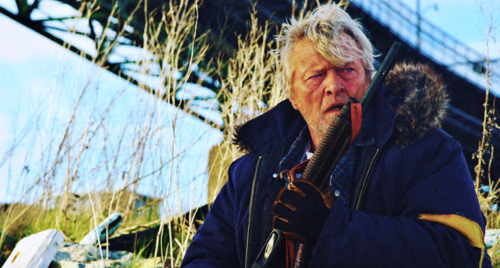
It has been quite fun to watch these guys and their passion for film take them from a trailer shot in Dartmouth, Nova Scotia to a feature length film starring Rutger Hauer. I send you guys huge congratulations and am glad the world is getting to see another side of Canadian cinema.
One of my favorite genres in film is the action film. Nothing beats a high speed chase through city streets, a gun battle, the odd explosion, perhaps a fight in which one dude fights five other dudes. In short, nothing gets the heart rate up and you on the edge of your seat faster then an amazing jaw-dropping action sequence.
If you have not heard there is a new festival that more then appreciates a good action film, ActionFest - The festival with a body count. ActionFest marked it's inaugural year last year. The festival takes place in beautiful Asheville, NC and this year falls on April 7-10, 2011.
What is also amazing about ActionFest is that this years profits, all 100% of them will be going to the Chuck Norris' Foundation Kickstart Kids. ActionFest will donate 100% of this year’s profits to the charity and attendees will have the opportunity to make individual donations as well. Giving a child hope is one thing, but teaching them to find the strength inside themselves to overcome adversity is the greatest adventure of all.
I am also quite honored to announce that I am one of a great team of contributors to the recently launched ActionFest Blog. The blog with a body count. You can check out the blog here. I hope to see you in Asheville this upcoming April.
When one thinks of Henry Rollins it is only natural to think of his work as a singer, a writer, and a spoken word performer. However, he has also put together an impressive resume as an actor, working with directors as diverse as Michael Bay to David Lynch. When Mr. Rollins speaks of his work as an actor he usually does it with self-effacing humor but his recent turn playing the character A.J. Weston in the Kurt Sutter creation Sons Of Anarchy suggests that Henry is an actor to be taken seriously. I recently had the opportunity to ask Henry a few questions pertaining to his work in film.
1) You have been quite self-effacing when it comes to your work as an actor however your work playing A.J. Weston in Sons of Anarchy proves that you have chops as actor. How do you prepare for a role that is the complete opposite of everything you stand for? How do you decompress from a days work?
The role was relatively easy because the guy was very free of emotional complexity. He is an unapologetic killing machine. He doesn’t ask many questions. The only pulse he has is that he likes his children. Past that, it was a process of eliminating emotion and getting to the thoughtless, order taking sociopath he is. I don’t really decompress. I just leave the set and go do something else. I usually have a lot of other things going on, so I go do it post acting work.
2) I think your work for the documentary H for Hunger is one of the most important things you have done. Could you talk about how you became in involved in the documentary? How can people see this film.?
I am waiting for the crazy director to put the thing out. I don’t know if he will get it together to do so. I think we did a good thing and I financed half of it and would like to get my funds back so I can do something else with them. I got involved when this psycho asked me to. It seemed like the right thing to do. It was. Too bad he’s not a rational person.
3) For H for Hunger you put up half the money, would you consider producing any other film projects?
I have some other film projects that I want to get active on next year. I don’t know when I will have the time but I will try to get at least one of them happening.
4) When one looks at your filmography one cannot help but notice some of the folks you have worked with, David Lynch, Michael Mann, Adam Rifkin, to name a few, what is something you have learned from these directors that you continue to apply in your film work?
I have learned to be very aware of what’s happening in a scene to hopefully be completely in the moment. The more I am prepared, the more I can forget I am acting and be more pure in my actions and reactions. I think that all great directors are like conductors. They already know the story will go and they need the actors and the cameras to do their thing. I like to fall into the bigger picture. Some directors are not all that good and they are just getting the shots like they have to turn it into some boss, they have no real vision of what the thing will be. There are a lot of directors like that. They are like teachers who teach to the test. No one really learns and in the case of a film, nothing really happens but what’s on the script.
5) What does cinema mean to you? Do you think films can affect people and help change people's perceptions?
I think films can have a massive effect on people, peoples, nations, etc. Film is more influential than music. I think it is a hugely inspiring medium. It’s also very manipulative and controlling. You put in the right sympathetic chords of soundtrack at that moment and half the audience cries, etc. You have to be careful with that kind of power. You can make great statements like Milk, or not great ones like Birth Of A Nation.
Brian Trenchard-Smith is one of the great genre directors, so much so that he is one of Quentin Tarantino's favorite directors. Quentin dedicated Kill Bill to Mr. Trenchard-Smith prior to Kill Bill's Australian premiere. I first met Brian at the Not Quite Hollywood premiere in 2008. Here is my vid talking to Brian, Mark Hartley and legendary Aussie producer Antony I. Ginnane.
1) Do you recall when you were first struck with the notion that you wanted to be a filmmaker? How did you begin to pursue this goal?
We lived in the small English village of Odiham in Hampshire. 3000 people, 7 pubs, one picture palace - The Regal. I was 13 years old, and for the first time I was allowed to go to the movies on a winter’s night by myself. (My mother, bless her, was a little over-protective, hence my later flirtation with stunts.) To get to the Regal on the outskirts of town, I had to walk through the cemetery of the Norman era church. Dark shadows. Wisps of fog. Knowing I was going to see a film crafted by a director dubbed the Master of Suspense made the graveyard all the spookier. That night I settled into the theater to see Alfred Hitchcock's VERTIGO
When VERTIGO began with the stunning Saul Bass title sequence propelled by Bernard Herrmann’s score, something took hold of me. I had seen films before, but this time I was transported into a new universe, rich in color, dark in motivation. My first encounter with an anti hero. And who better to confuse your loyalties than the inherently sympathetic James Stewart.
Of course, at age 13, some of the moral dilemmas and sexual undertones escaped me, but the film took me on an emotional thrill ride. I loved the way it made me feel, and I knew then and there that I wanted to make other people feel that way too. Thus my ambition was born. Luck and persistence gave me opportunity. My pleasure became my vocation. Obviously, I am no Hitchcock. I am no fencing champion either, but I still compete.
As to the how, I pursued my goal by getting into the film industry anywhere I could. Initial attempts in England were thwarted by the ACTT (UK film union) policy of a closed shop. So I went to Australia, the land of my father, and got a job in a TV news department as a film editor. Then I moved into TV promos, which in turn led to a US company National Screen Service hiring me to make trailers in the UK. Sergio Leone's Once Upon A Time In The West was one I did. Then the Australian Channel Nine Network made me an offer I could not refuse: come back to run the network promos AND make programs for us. After a couple of years doing that, I formed my own company and made my first independent production the 50 minute dramatized doco THE STUNTMEN which won an award in Australia. I was up and running thereafter as a freelance film maker.
2) You have been making films from the early seventies, what changes (positive/negative) have you seen to the film industry over the years?
On the positive side, the new technology has brought fantasy and spectacle within the grasp of the low budget film maker. In regards to the negative aspects of the film industry, Hollywood eats its young and discards its old. In the piranha pool of studio politics, executives prefer the sizzle to the steak. They confuse good photography with good direction. MTV has dumbed down story telling. Then there's piracy, made easier by the new technology. How do you protect copyright and monetize the internet? The list of negatives that assail the business we love is long and multiplying. But we must battle on...
3) What are some of the challenges that face filmmakers today? How do you overcome them?
It's a very crowded and noisy marketplace out there, made more competitive by the shrinking economy, the downsizing of drama production, the high cost of theatrical release. But, as I said, we must battle on.
4) Your films have had a lot of great action scenes and you've worked with some great stunt people, i.e. Grant Page, was there ever a stunt you had planned that you said was far too dangerous to attempt? What were some of your personal favorite stunts you have put on film?
We never planned a stunt then ruled it too dangerous. We often studied the probabilities, made predictions, modified it or broke it down into more manageable sections. The one stunt Grant will never do again is the leopard fight in DANGERFREAKS. You cannot predict a leopard. It's hard to pick favorites but the film STUNTROCK holds a special place for me.
5) How has your approach to shooting an action sequence evolved over the years?
As far as shooting action goes, I’m in favor of quick cutting, but against turning a fight scene into a blizzard of telephoto images. My cinema brain likes to process fast, but in order to maximize my enjoyment of the sequence, my information organizer needs to be reminded regularly of the spatial relationships between participants. The framing must also take into account that invisible proscenium arch through which we tend to see our daily lives. We need to step back, if only for a flash, to the standpoint of the witness. The prevailing wisdom is to keep the audience inside the action for maximum involvement. I believe this only works with the support of interwoven images that show the participants head to toe engaged in a brief dynamic movement across the frame. The close quarters style has been in vogue for a while, perhaps geared to capturing the attention span of gamers. But I think audiences sometimes can be just as riveted by a sustained action being depicted in one shot.
6) Lastly, one of my favorite things about film making are the great stories you hear about the actual process of creating a film. Is there a story you wouldn't mind sharing during the making of one your films?
Here is a day on one of my film sets. It's late in the day and the film crew is making the final preparations for a complicated shot. Dolly track has been laid to converge on a tree with sprawling roots. I'm looking at my watch as we are losing time. The Guest Star Who Has Seen It All watches nearby with bemused interest. I'm looking at my watch again, as if willing the minute hand to stop, and if possible go backwards. Fluff and Buff, the hair and make-up artists, dab sweat from the brow of the Actor, standing at the base of the tree. Given that the temperature is over 100 degrees, this is a noble but futile effort. The Actor is anxious.
The source of the Actor’s anxiety arrives on the set, his partner in the scene, a male with dangling testicles the size of grapefruit. Sudan, a large African movie lion, is led out of the bushes on a chain by two Trainers. Two other Trainers follow, carrying short poles. As the Trainers tether the lion to a spike embedded beside the far end of the dolly track, Sudan yawns, and licks his lips to cool them.
Everything is in place for the take. The Trainers have been positioned out of shot to protect both the Actor and camera crew, should the lion stray from his designated path. The collar round Sudan’s neck is concealed beneath his shaggy mane, and the trailing leash masked by his body. The Actor has practiced limping backwards while swinging a burning firebrand to deter the advancing beast. The dolly grip and operator have rehearsed the camera move that will keep the lion on screen right with his retreating victim on screen left. It’s a travelling geography shot that will add tension when inter-cut with compatible dolly shots on the faces of the lion and the Actor.
I want the audience to see the lion and the Actor in the same shot; not a static shot, which could be achieved by the elements being photographed separately with a locked-off camera, then fused in the lab, with the vertical split disguised by a tree trunk in the close background. This would spare the Actor any proximity to the King of Beasts. No. I want a Movie Shot, not a get-it-done-move-on episodic approach, but a sense that the camera is almost mounted on the flank of the lion as it slowly closes in on its prey.
The time for this glorious cinematic moment has arrived.
The Prop master lights the firebrand again. The 1ST AD calls for turnover in Spanish.
The crew, a well oiled machine, commence their respective duties. The Chief Trainer calls commands to the lion.
I'm hovering beside the camera, which is keeping pace with the ambling lion. Sudan is fascinated by the firebrand, and reacts to its movements. The Actor is In The Moment! Everything is working perfectly.
At this point the TRANSPORTATION CAPTAIN arrives on set to watch the shot. The 1st AD sees him, and a long simmering feud chooses this moment to erupt.
The tension-meter on the set spikes. Hungry lion, anxious actor handling fire, two departments inching towards civil war, complex dolly shot, etc. It’s understandable. But the net effect of the expanding angst is to push the Actor into the truth zone. It’s a great performance, swinging from fear to rage and back again. Meanwhile, the other drama continues.
Oh, boy! Now we’ve gone to Def Con 4. After soiling each other’s mothers, there is only one stage the conflict can move to…The Slap.
The Transportation Captain slaps the 1st AD’s face, not to inflict physical pain, more of a formal gesture, a challenge. Some men go red with anger. The 1st AD’s complexion goes pasty white. His eyes blaze. Detonation is immanent. Luckily members of both departments seize the potential combatants and hustle them to separate corners of the jungle.
The Lion sits down at the end of its leash, awaiting reward. The Actor has started to enjoy himself. Lions? Hah, they’re pussies. The Director calls for take 2. There’s no producer on the set to stop him.
This actually happened. Almost twenty years ago. The Actor was Canada’s great Chuck Shamata, whom I have cast in two movies since. The Guest Star was former Tarzan Ron Ely. The Lion Trainers were the incomparable Boone Narr and Hubert Wells, and the Director obsessed with getting a tie-in shot was yours truly.
So the purpose of this story is the issue of conflict resolution. Every movie mixes good intentions under pressure with powerful egos. There Will Be Blood, if you do not head these situations off at the pass. I had ample warning that the clash of personalities was gathering momentum, but chose to ignore it. Naturally Murphy’s Law applied, at the most precarious moment. So I have learned over the years to develop an ear for seismic pre-shocks, and use diplomacy, humor, bribery, alcohol, whatever it takes to help the parties see each other’s virtues. Too often crews work in an atmosphere of politics, blame and fear. No one gives their best under those circumstances. Part of a director’s job is to set the tone in the workplace, encourage communication, and make everybody’s hard work FUN.
My original intention was to take a break during this holiday season from writing, however with what we are seeing with Iranian filmmaker Jafar Panahi and fellow filmmaker Muhammad Rasoulof being sentenced to six years each in Iranian jails for making films is not only an outrage for cinema but much more importantly for basic human rights. Being silent is not definitely not an option.
On December 20th, 2010 Jafar Panahi and Muhammad Rasoulof were sentenced by the Iranian government to serve six years in prison for making a film about the Ahmadinejad election. Also part of the sentence are the stipulations that Mr. Panahi not make films, write screenplays, grant interviews or leave Iran for twenty years. Jafar is currently fifty years old so you can take those stipulations to their logical conclusion. You can read more about the case from this L.A. Times article here.
I strongly urge you to take a second to add your name to a petition demanding the release of Jafar Panahi.
There are many petitions online, here is a link to one of them. Petition.
Adding your name to a petition is not only demanding freedom for Mr. Panahi but for all political prisoners of the current Iranian government.
Here is a video I found to give you a glimpse of what life - if you can still call it that - is like inside Iranian prison.
To say that social media has become a great tool for independent filmmakers would be a vast understatement. It has made the undertakings such as marketing, raising a budget, to just meeting one another and sharing stories just a little bit easier.
It was through Facebook that I first met filmmaker Lucas McNelly, who at that time was based out of Pittsburgh. It was not too long that I began to see the progress of his first feature film Blanc de Blanc show up in my news feed. I have been watching his progress from making Blanc de Blanc to the near impossible task of having a low budget film play theatrically.
Lucas has followed up his first feature with his second film Up Country which is currently in post production. While this is going on he is also transversing America on his latest project A Year Without Rent. The A Year Without Rent film project really piqued my interest and I thought it was a such a great idea that I wanted more people to find out about it. Without further ado here is my recent conversation with Lucas McNelly
1) First as a means of introduction could you talk about the features you have directed, Blanc le Blanc and now Up Country?
I've directed two features. Blanc de Blanc (www.blancdeblancfilm.com) was part of the #2wkfilm project, where a couple of filmmakers challenged each other to shoot and edit a feature film in just two weeks. What we ended up with was a mystery about a guy who shows up in Pittsburgh, meets a girl, and then his past shows up. Considering the obvious limitations, it ended up a lot better than it could have been. It's a rare mystery in that we don't solve the mystery for the audience. So far, 8 people have figured it out on their own. But, we've gotten a ton of really interesting theories.
Up Country is a thriller that is currently being edited. It's about 3 guys from the city who hire a guide to take them fishing in the Northern Maine woods. The guide abandons them in the woods and steals their gear, leaving them to fend for themselves. We shot it in the middle of nowhere on a tiny $4k budget with a cast and crew brought in from around the country. We're pretty excited.
2) How has your approach to directing changed from you shorts (L'Attente) to now (Up Country)
I think one thing I've learned is how to give up control without sacrificing vision. On L'Attente, I did everything. One thing I've tried to do since then is find people who are better than I am to do things like DP or sound. Similarly, I've found that while it's a lot of fun to hear actors say your words verbatim, and it's a great ego boost, the better you cast your actors, the more control over the dialogue you can give to them. And, really, the more you give up, the deeper that dialogue gets. Of course, that can easily become a disaster, so you have to be careful.
3) What are the challenges you have faced trying to get your films seen? How have you tried to overcome these challenges?
There's a ton of stuff out there people can watch, new stuff and old, so I don't know exactly how you overcome that consistently. Really, you just have to keep plugging away at it. People are busy. It seems the best method is to get connected with people and spread the net a little bit further each time. But, I don't know if there's a magic formula. If there is, I certainly haven't found it.
4) What is the Year Without Rent film project? How was this idea conceived?
Like all of my ideas worth a damn, A Year Without Rent started as a half-assed theory. When I was making Up Country, we brought in people from out of town. At the same time, I had friends doing other films around the country. It occurred to me that the hardest part of getting people from out of town involved was the travel, so how cool would it be to solve that?
The idea basically was that if someone could travel around the country and volunteer on films all over the place, just that extra set of hands would be a huge help to those films. And really the only way it could be more helpful than that is if that person also helped promote the film as it was being made.
I'm rambling a little bit, but essentially I'm gonna spend a year traveling around the country, working on indie films, stopping at festivals, and basically exploring the landscape of indie film. Along the way I'm going to document the process through video, photos, and good old fashioned blog posts. What we'll do is look at indie filmmakers, seeing how filmmakers around the country work, how they operate, stuff like that. Just how mobile does social media make us? Do we need to live in NYC or LA to function?
It's a big, sprawling project. At the end, we'll compile the whole thing into an eBook (or whatever is cool a year from now). And hopefully we'll be able to help out a bunch of filmmakers in the process.
Right now we're raising money on Kickstarter (http://kck.st/dExFQg). The perks are pretty awesome, and hopefully they'll keep the audience involved throughout the year.
5) What do you hope to achieve with this project? How do people get involved?
Really, the project will only be as good as the film community lets it be. The more people and projects that are involved, the better it will be. The bigger the audience gets, the more benefit there is for the films. We're hoping to add people to the project for short stretches, as possible.
3. If you want to get involved in a more tangible way, there's a bunch of different ways to contact us. Either via twitter (@lmcnelly or @YearWithoutRent) or emailing us ayearwithoutrent [at] gmail.com. Really, we're pretty easy to contact. And we're super nice.
6) What advice would you offer to people struggling in the goal of trying to realize their films?
There's going to be 5 or 6 points in nearly every film where the whole thing teeters on the edge of collapse. That's natural. The difference sometimes between success and failure can be little more than just being too stubborn to give up. For example, on Up Country at one point we lost our lead actor and DP on the same day. But, we just shrugged it off and found someone else. You can't get discouraged. Well, you can, but you can't give up. And if the film falls apart, start working on the next one.