John Candy: I Like Me the new documentary about one of the great on-screen comedians of all time John Candy had it's world premiere at the 50th edition of the Toronto International Film Festival. The documentary was directed by Colin Hanks. It was produced by Mr. Hanks and Ryan Reynolds and a slew of other notable folks. How do you arrive the red carpet premiere? In a 1986 Chrysler LeBaron convertible of course! The car made famous in Planes, Trains & Automobiles. Look below for an exclusive video of the stunt person face timing Ryan Reynolds as he gets The Lebaron in perfect....or not so perfect red carpet shape!
Degrassi: Whatever It Takes has it's Toronto International Film world premiere today. Here is a trailer that just dropped for the documentary. Check it out!
Did you encounter George Orwell’s writing before deciding to make a movie about his life and work? Did you read him directly, or had you already absorbed some of his ideas through popular culture, or thinkers working under his influence?
Of course, if you have gone to school, if you have gone to university, then you have to cross paths with George Orwell. That’s obligatory. I grew up in many different countries and in each of them, Orwell is (was) a known commodity. But, politically, there were more important thinkers in my life, especially coming from the Third World. My political focus was rather about the North/South axis and tensions than the West sulking on its own problems. I probably had some suspicion towards Orwell over time. When you talk to people on the left specifically, some had a troubled relationship with his political evolution. He was suspicious. Before I started this project, I talked to two writer friends—both very famous, I won’t name them—and asked them if I should make a movie about George Orwell. One of them is British, a Marxist, still very left wing. The other one is American. One said that I shouldn’t do it, the latter, amused, was looking forward to my take. These are both people with whom I share certain experiences and positions, so it rather energized me. And now, more than ever, I feel very much closer to Orwell’s way of thinking—his autonomy of thinking, outside of any sort of dogma.
Resisting dogma is a major theme of his work, which is why it’s interesting that some critics are dogmatic about him: his politics, his ideology, his affiliations...
Well, everybody has claimed Orwell. And there are many instances that he would have disagreed with. Like the CIA, which put a lot of money into the first film production of Animal Farm. For them, that book and “1984” were perfect propaganda that could be used against the Soviet Union. Even though Orwell did use extensively Stalinism as the central vehicle and inspiration for these books, but he was not strictly referring to what was happening in the communism countries in the east. They were only very potent examples. Orwell’s analysis and criticism was not exclusively towards the East. He was also talking about democracies everywhere on the planet. He was talking as well about England and other European countries. As he wrote: “But to be corrupted by totalitarianism, one does not have to live in a totalitarian country.” People tried to fit his work towards their narratives during the Cold War, but they did it using one small part of who he was.
Your film deals with Orwell’s writing and his biography and how the two are linked; the impact of growing up in India and observing imperialism first-hand is significant. The photo of the infant Orwell being held by his Indian nanny is striking and very resonant—you use it to bookend the film, and to draw out a number of different ideas and meanings...
That photo became something of a reckoning for me. I thought: ‘Oh! Orwell is a brother. This is somebody from the Third World!’ If you grow up as a child in the Third World, it changes you and your view of the world. You can ask any “westerner” who grew up in Africa or in India and their view of the world have turned either totally racist or genuinely universal. That was a starting point for me. I was working on my film about Ernest Cole, and there was a sequence where you see these nannies in South Africa—Black nannies taking care of white, blonde children. You understand the absurdity of racism when you see how those white parents would hand the most valuable being in their lives—their child—into the hands of people they totally despise, people who they consider as basically animals. How totally fucked up is that? One of the nannies says in the film: “I love this child, but I know when she grows up she will be just like her mother”. This picture of Orwell with his black nanny connected me with him: he just turns out to be a fine human being. The interpretation of this picture at the beginning of the film differs from the one at the end of the film. It’s the same photo but it means two different things. At first, we see it and think. That fragile child with his black nanny. A uniquely warm, innocent and exotic childhood. And then the second time, at the end of the film, it’s scarier. You think ‘Oh my God... That woman would have every motive to just strangle that child’. There is a sense of unease and panic. It’s as if the whole history of the world hangs on the nanny’s ability to be a correct person, not to violate that trust and that original bond.
The image of Orwell’s birth rhymes with what we know about his death; the disease that rendered him weak and helpless. That feeling manifests in 1984, in the scenes of Winston’s torture and degradation, the way he is infantilized by his tormentors...
I knew from the start that I had to find a human and emotional point of entry to Orwell’s life and work. I had to find his “boiling point”. That point is more often than not the birth of something original, bold, determining to start threading a narrative. I don’t make biographies; I choose a moment in the life of a character that allows me to tell the bigger story. For Orwell, I found that moment quite rapidly. It is the last year of his life. At that time, he pretty much can guess that he doesn’t have much time to live. He's struggling to finish that novel that will make him famous and that he will not even live to see. He died four months after releasing 1984. He will never know the impact of that novel. The dramatic undercurrent of the film tension and dialectic lies on this state of his life between life and death and the struggle of finishing his “last” novel.
Do you feel that you came to understand Orwell as a person as well as thinker while making this film?
I think I did not only understand him as a writer, a thinker, but also as a human being. Without that, I don’t think the film would have made sense to me. Even in terms of how I see the world today, this understanding was key.
At the end of 1984, Winston mentions the proles, which is not just the proletariat—it’s something bigger. It’s the whole planet, including the “Third World”. And I am trying to reclaim Orwell for that third world, for my side of the world. Just as I cannot make a movie about a writer or a thinker whom I do not fundamentally understand and whose work I respect. I did films about James Baldwin, Karl Marx, Patrice Lumumba—people I understood profoundly. I knew their fight, their conflicts, their demons even that fueled their bold and unique undertaking. With Orwell, it was the first time I was going into a film without a deep personal connection to the subject, but I was able to find my bearings very early on. As soon as I re-read this incredible and lesser-known essay entitled “Why I Write,” I knew I was there.
You quote more extensively from “Why I Write” in your film than any other piece—more than 1984, even.
That text is him. It’s all of him, it’s a confession. It’s an act of contrition. He’s not hiding anything, “...I was part of the actual machinery of despotism”, having “bullied” the natives and even hanged a few, his despise of his own social class and the classes above, the hardship of imposed poverty in London and Paris, to experience “reality”, etc. You see the man, with all of his flaws. It’s not a lecture; it’s about putting a mirror up to his own face. That idea of the mirror—that’s something else I want people to understand. I have a lot of trouble every time I hear columnists talk about “dystopia” or calling him a “prophet.” He was of course not a prophet. He was talking about the world around him. It’s not a projection, it’s an analysis. He’s working through it all: what he went through in British Imperium; what he went through in the Spanish Civil War, what he experienced in England, in Paris etc. He’s analyzing the early days of the Cold War. It’s not prophecy. It’s the world as it is, as he was living it.
What do you think differentiates Orwell’s analysis from later generations of writers?
The way I see it is this: in the 1970s, most serious writers needed to have a tremendous amount of general knowledge—about poetry, about history, about culture, geography etc... It was not as much about their inner lives or “feelings”. Inner life was the fuel, the Zeitgeist they used it to power the rest. The recent decades, through what we could call a “democratization” of culture, and concurrently the focalization toward “the inner self”, almost anybody is entitled to write. Any experience is allowed to be printed and commercialized. You don't need the more general deeper knowledge of the universe above you nor the idea of the “collective “. You no longer must refer to the world around you. You ARE the world (or it revolves around you, personally, intimately). We have lost the collective mind. We have lost the collective fight. I can see it in the generation after me. Nobody thinks about death the same way today, about risking one’s life for a cause. When I was studying in Berlin, I knew that I was going to go back to Haiti and die. My friends from South Africa, they knew they were going to go back to South Africa and die. My Iranian friends knew it, my Nicaraguan friends, my Brazilian friends, my Chilean friends. We all knew.
We didn’t talk about personal faith so much or about personal struggles or feelings (Not that it was a good thing. On the contrary. But it was just not proper). When the Berlin Wall fell, there was no stopping of the exuberant capitalism cries of victory. Capital had won. And so everything else that came with it. It was a complicated world, and we needed writers with a wealth of universal knowledge who could help us understand the moment beyond the allegorical Fukuyama’s “End of History”. But on the contrary, we went for full blown fragmentation, specialization, and individualism, inner soul and self-wellness among other developments. And this is in every field of all society, media, academia, politics. We lost the collective, the overall analysis. Everybody focused just on what they could chew and got lost in petty details.
In some ways, the right wing—at least in the West—has done a better job capturing the collective imagination, in politics and in popular culture as well.
It is always easier for those forces because they don’t have to care about the multitudes, nor about the truth or the nuances. They just have to care about their profits. Capital not only has no frontier, but also tends to control politics, through different tools and procedures. To a point where any powerful president, at least in western democracies, merely has a negotiation power. We can see how President Obama, besides having inherited one of the major capitalistic crises in history, still was under the sway of the Wall Street power brokers. Every move or economic decision was the result of heavy discussion and compromise, in which more than once, banks and industry well-being were privileged over citizen interests.
Authoritarian regimes operate with less moral qualms and restraints. The ending of A Face in the Crowd comes to mind — except that instead of being exposed by the television cameras, authoritarian leaders are emboldened by them. There is no limit. If you just let it go on there is no ending.
In Germany in the 1930s, Hitler took at least six, seven years to become Hitler. The establishment thought that they would “control” him at the end. He had written out what he was going to do in Mein Kampf. And nobody took that seriously. It’s the same with Project 2025. At what point do you start to take warnings seriously? Bullies, authoritarians—they have no limit. It will get worse and worse until they are stopped. It's not right against left now. It’s an authoritarian regime. It’s Big Brother. It’s the same with authoritarian playbooks today, in many countries. The names change; the goals don’t. They target institutions, courts, media, civil society. They follow the same script as abusers: isolate, humiliate, intimidate. They’re predators. And unless stopped, they escalate.
I grew up in many different dictatorships. Whether it was Haiti, or whether it was the Congo... we could feel early on when something was going wrong. It’s when people cannot speak their minds anymore, when you must think twice before saying things in public, or addressing certain topics. That’s what dictatorship is. It’s little by little.
Did you know at the beginning how much contemporary politics in general—would be threaded through your portrait of Orwell?
That all came very quickly when I went through “Why I Write.” I wrote a one-page summary for our investors, and the film was all there right from the gate. Except that I didn’t realize at first that it would go so deep and dark and morph so close to our reality. When the project was proposed to Alex Gibney and then myself —we knew that we couldn’t say no: we were being offered access to everything Orwell had written. The same access I had gotten with James Baldwin’s body of work, who, as I said, was closer to home for me. When you have that kind of access and you don’t make a great film, you’re in the wrong line of work. With Orwell, it was also a once in a lifetime opportunity. What I knew I needed to find was the connection to the world I’m living in, and that’s what I mean when I say Orwell is a “brother”. He saw the world in a way I can relate to. I had my share of Big Brothers throughout my life. In my youth, the U.S. was supporting dictatorships in Haiti, killing Lumumba in the Congo and staging numerous coups in foreign countries. And Newspeak was always part of my reality. When they say “democracy”, it was never meant for the likes of me. I grew up with Newspeak. I grew up with Big Brother. In the Third World, we all grew up in the shadow of Big Brother.
The language of euphemism is another major subject in the movie; it’s the language of corporations, a sort of airbrushing of agendas, the rhetoric of hard-sell advertising.
It's corporate, it’s political, it’s military. All of it. As a Black person, my life is about deconstruction. Why do we deconstruct? Because we know that what we are seeing is not our reality. We grew up deconstructing Hollywood films because we knew that when we were seeing Indians being killed by cowboys, that they were us. To enjoy the film, we had to deconstruct it, to make it accessible (or acceptable) to us. The ironies and contradictions were obvious. Hollywood was never a “dream” for us. We grew up with that dichotomy. The movies were Newspeak.
Because American movies are so big and expensive they can be hard to deconstruct. They’re made to be solid, to be impenetrable. They’re weapons of soft power.
That power was never totally “soft” for us. The traces linger for very long. Soft power is never innocent. If you live in the West, there’s no need to deconstruct that power. That's the privilege that you have: you don't have to. Elsewhere, if you don’t deconstruct that power, it will kill you. For a more profound and definitive analysis of this, and way more eloquent than me, I would recommend The Devil Finds Work from James Baldwin. That’s what James Baldwin said about Hollywood in The Devil Finds Work.
Baldwin’s profile has been raised in the years since your documentary. There were two different movies this year—Eddington and Sorry, Baby—that used him as a reference or a signifier, and of course there was Barry Jenkins’ adaptation of If Beale Street Could Talk.
Yes, Baldwin is back, baby! As he should be. And I am glad that a whole new generation is reappropriating his work anew.
When Barry Jenkins made Beale Street he invented a new genre, a new way for black actors to work and play their parts. I have worked with black actors for forty-five years, and I can see how Beale Street was a successful attempt to propose something new, that is not a cliché. American movies reproduce cliches over cliches over cliches, sometimes ironically, sometimes not. [Jenkins] succeeded in finding a new way for actors to show emotions, to show pain, to show joy, to show love.
Is it fair to say that more movie critics have read Orwell than Baldwin?
By the sheer mathematical reality, it is evidently true. But I'm not sure that many more now have read Baldwin, if it is only to keep up with the flow.
That being said, I am sure most know about Orwell as “the prophet” rather than somebody who is actually writing about the real world. The thing about Orwell is : everything he wrote, he went through himself. The editing of the movie tries to reflect that. We can see how the physical reality of his illness—his tuberculosis—finds its echo in the rendering of Winston in 1984, where the motif of the ‘lungs’ recurs throughout. We can also observe how Orwell’s own complicated behavior with women is mirrored in the strange, often uneasy and sometimes disturbing dynamics of Winston’s short-lived and tragic relationship with Julia (‘Do it to Julia, not me!’).”
He could be an awkward man in real life. He was awkward with women. With his last wife, Sonia Brownell, he asked to marry just a few months later after meeting her although his health was already severely impaired. I can hardly believe that he was even in love. His work was his life story. He could only write about things he went through. If you read 1984 as a prophecy, you will really miss out on Orwell's essence.
There’s something adolescent about Orwell: a sense of idealism that never faded as he grew older. It’s also palpable because he had such a short life.
The adolescence you’re talking about is only possible in the West. Because you can afford to be a fully grown adolescent in the West. Orwell, protected himself from that delusion through humor, sometimes even through cynicism and wit. His distinctly British sense of distance probably saved him from despair. Because he “knew” and could not “unknow” what he had seen.
How did you go about organizing the material in the film?
My job is to find a way to make a movie that’s accessible for everybody, not just for literary savvy people. We read everything—everything that Orwell wrote and then I started to make selections from the text. I knew that I had to come up with a sort of libretto, the same way I did for James Baldwin. Making a film is obviously not like writing a book. It’s closer to the way you might write an opera, except that you’re using somebody else’s words. Orwell’s words are strong. I have to be careful though to not twist his words. My work on Baldwin did help me a lot. His humanity was closer to me and easier to handle. Orwell is more... British. You have to find the emotion in it. We took a lot from “Why I Write” because it’s more sincere, human and direct— both about himself and about the society he is writing about. It's perfect material for a voice-over.
The movie includes footage of the war in Ukraine and Gaza; these are very charged images to put in a movie about a writer who died seventy-five years ago.
I’ve been making films for 40 years. All of the movies I’ve made are about alarming people to the state of the world. I’ve never made a film that I didn’t totally believe in. And making 2+2=5 was basically like watching the news. For example, I was re-reading 1984. At the very beginning, Winston is writing his journal: “April 4th, 1984. Last night to the flicks. All war films...”. Then he basically described how the coast guards are bombarding a boat full of refugees in the middle of the Mediterranean. Sounds familiar? This gives you the chills. You basically just saw that in the Evening News! Orwell is exactly what’s happening now. Even the audience’s reaction, us, sounds so familiar: We don’t care. Every day boats are sinking. Nobody stops it.
The Zone of Interest comes to mind—that vision of compartmentalization, of living adjacent to suffering.
I lived like that in Germany for fifteen years, in that state of mind. I talked about it in Exterminate All the Brutes. I’m Black, not Jewish, but the Holocaust was also my reality. I did my film school essay at Plötzensee, a Nazi torture chamber in the middle of Berlin. There is that phrase “never again.” People see it as a philosophical sentence, barely a warning nowadays. How many people repeated “never again” again, and again, and again. The same countries that were the “liberators” do this everywhere else. It takes different forms, but you know, it’s the same.
I’ve done several films about genocide, so this is not new to me. Orwell is just the latest one. People need to look at their reality. Consumerism has overcome the West while the rest of the world is looking. They know it’s all an illusion. That you are in a sort of a bubble.
There are refugees on every corner in Paris today, or in other European capitals, where people are just being pushed from one corner to another. Just wait for the next Alcatraz city. Yet, they are the ones doing most of the “second front” to use a covid popular term. Delivering food every day, working at meat factories, taking care of the elders, etc... they were dying by the hundreds during COVID. That’s the part of the world that’s watching the “opulent” West (of course we know that it’s not opulent for everybody). I doubt that they still believe in all those well-meaning words, like democracy, justice, human rights, etc.
In the film, you quote the end of 1984, the idea of a faint hope in the darkness. Do you think that hope is real? Or is it just another platitude?
There cannot be hope without understanding. Marx wrote the same thing: you can’t push people to the barricades if they don’t know what they’re fighting for, if they don’t understand the whole system and why it is making them miserable. You can go to the barricade and burn down everything out of anger, and then what do you do after that? You still have to rebuild something. It can’t just be Christian hope—the hope that “it’s going to get better.”
Maybe it’s not hope we need; maybe we need reality. We need to cease just being consumers. We even consume democracy! We choose for whom to vote like we choose a soap bar. “Let’s try this one this time.” It’s consumerism.
What I know for sure, history doesn't function with “hope”. If you want change, you need to act upon it. If we just stare, it will just be somebody else’s plan.
There are people who really do believe that 2+2=5, of course. And others who may not believe it, but find it easier to say it.
Some people may believe that, but I don’t need to indulge in their craziness. In the beginning of the film, there is a clip of Orwell with his son Richard as he advises him: “always know that two and two are four.” Some people will tell you that two and two are five. They are called governments... big corporations. ...They will torture you... they will bribe you... etc...” In hard times, we need to have the courage to say that: “Two and two equals four” That’s what the film is about.
The Eyes of Ghana a 50th edition of the Toronto International Film Festival official selection received a standing ovation Thursday night at it's world premiere documentary selection opener film. The documentary is directed by Ben Proudfoot the Academy Award winning filmmaker of The Queen of Basketball The Eyes of Ghana puts a spotlight on soldier of cinema Chris Hesse preserved over 1300 film reels documenting the history of Ghana. Barack and Michelle Obama are Executive Producers of this extortionary Chris Hesse and this incredible look at his life. Enjoy these great posters!
I have joined the feature length documentary Tales of Zone 7 (An Oral History of the Making of Cherry 2000) as a co-producer. This making of documentary will be featured on the 4K release of Cherry 2000 which was written and directed by Steve De Jarnatt who also wrote and directed Miracle Mile.
Cherry 2000 is a cult movie from 1987. It stars Melanie Griffith who plays E. Johnson who is a tracker hired by a businessman Sam Treadwell (David Andrews) to replace his android wife - the titular character Cherry 2000 (Pamela Gidley) who has shorted out.
Johnson and Treadwell wind up in the wasteland and wander into Zone 7 which is a lawless and dangerous place currently under the tyrannical rule of Lester (Tim Thomerson). What does it mean to love? What does it mean to be human?
Robert Aaron Mitchell with director Steve De Jarnatt
There is still time left to join the campaign. There are lots of different options available to contribute to the finishing of this making of documentary and other supplemental materials. Click here.
I am thrilled to announce that The Bobby Diamonds Story has won Best Short Documentary at the Tokyo International Short Film Festival. Yesterday I received the award. Click HERE for an interview I did with the Tokyo International Film Festival.
In 1985 Sylvester Stallone had two of the top three highest worldwide grossing movies. Both sequels. Rocky IV and Rambo First Blood Part II. That is absolutely remarkable. As an actor Stallone has been ubiquitous for decades. What do we really know about Stallone the person behind the action movie icons. This is what Thom Zimny sets out to do in his documentary aptly titled, Sly.
In the opening title sequence we see glimpses of Stallone's house. As ubiquitous as he is in movies and the popular culture, so to is his own image in his house. From action figures, to posters to statutes. We see the Academy Awards, snippets of the art collection, the scripts, the view from the Hollywood Hills.
"It is really easy to become complacent." Starts of Sylvester says in the opening sequence of the documentary. He is in the midst of packing up his mansion to move back East to break up the feelings of dissatisfaction with the state of his current life.
One of my favorite early sequences is of Stallone going back to Hell's Kitchen to reminisce about his New York City upbringing. Also when he is home watching movies and talking about the role models he found in film, James Cagney, especially Steve Reeves of Hercules fame.
Sly's childhood was transient and nomadic. He went throw thirteen schools in twelve years. It was the stage where he found home. He landed a role in Arthur Miller's Death of Salesman. A teacher told him he should pursue acting as career. Sly cites this as a moment that changed his life. Back in New York he was homeless and struggling to get any kind of role. The only thing he could get was off off Broadway. He started getting roles as thugs.
Stallone started writing his own screenplays with John Herzfeld. Another life changing decision. Write out his frustrations and perhaps get somewhere. Every weekend he and Herzfeld started writing, writing, writing. He would break into to movie theaters all over the city to see films.
I have never heard of the film Horses prior to this documentary. The premise of the movie now has me seeking this out immediately. A Cowboy and an Indian return from their graves a hundred years after they were hung. The cowboy's father was also reincarnated as a the sheriff he was to track them down.
As far as documentaries go there is nothing about the technique or the choices on how to film the subject and the use of photographs and other visual media that is groundbreaking or innovative. As a viewer you are either a fan of Sylvester Stallone or you are not. That determines how much or how little you will gain from Sly and how much you will be entertained.
As I watched this documentary one of the most compelling aspects was sitting in a car, or walking down a sidewalk or sitting down and listening to Sylvester Stallone talk, reminisce and ponder his life. That is one of the paramount things we learn about Stallone in this documentary is how compelling, fascinating and - still to this day - we as an audience are drawn to him.
Wallsby Kaisa Smutniak is having it's world premiere in the Documentary Section of the Toronto International Film Festival. Above you can see the poster released for Walls for the premeire screening. The premiere screening is Sunday September 10, at the Scotiabank theatre at 12:45 p.m. Miss Smutniak returns her country of Poland to examine the countries border policies and the greater refugee crisis. Below is an exclusve clip from the documentary.
The Bobby Diamonds Story now has a poster. The poster reflects the duality of a poker player as well as the duality of the story the documentary unfolds. The film also recently won Best Documentary Short at the Tokyo International Short Film Festival joining the film's win at the Venice Fullshot Film Festival.
Director and writer Robert Aaron Mitchell also recently did an interview about The Bobby Diamonds Story and film making in general. You can find that interview HERE The film's iMDB page is HERE
"At the beginning, there's nothing. There's no concept of a robot
explorer crawling across the surface of another world. And then,
gradually, you start to think. You start to act. We just start to build.
And those machines come to life." the principal scientist on the
Opportunity mission. Steve Squyres
Oppy is the affectionate nickname for the Mars exploration rover named Opportunity. Oppy was expected to be operational for 90 days and wound up roving the red planet for fifteen years. In Ryan White's documentary, Good Night Oppy. Ryan White has directed previous documentaries, notably, The Case Against 8
which was the behind the scenes look at overturning California's ban
against same-sex marriage and a film I helped screen at The In Light
Human Rights film festival in Bloomington, Indiana in 2014.
White and his team follow the rover and the scientists over the course of Opportunity's lifespan. From the ten years of proposals until NASA gave the green light to begin the program. To how would they get the rover to Mars. How do you get the rovers to land on Mars without damaging the robots. How do you build the machines so they can roam the arduous surface of Mars. What cameras and other equipment to you put on the rovers to collect and transmit data? The rovers began to be created at the Jet Propulsion Laboratory in Pasadena, California. "It's just a box of wires, right? But you end up with this cute-ish looking robot that has a face." Doug Ellison, camera operations engineer.
At one point early on we see Oppy navigating the surface of Mars and stops at it detects a hazard. It is only Oppy's shadow and NASA informs the robot rover she is safe to proceed. In 2003, twin sister robots named Opportunity and Spirit were sent to Mars.
One of the great sequences in the documentary is watching the scientist figure out the airbag landing system to get the rovers to land safely on Mars. We see people sewing this giant airbags. We watch the creation and testing of the parachutes. One of them crash to the surface during a test. That was going to be one of the parachutes that were going to go to Mars. There is genuine suspense as we follow the trials and tribulations of undertaking this mission to Mars. There are so many things that have to go right for any scientific space exploration mission and there are so many more things that can go wrong.
"And along come Opportunity. And on every test, Opportunity came through with flying colors. So, even before they left this planet, Spirit was troublesome, Opportunity was Little Miss Perfect." Doug Ellison. We see Opportunity take her first steps. "To say that it is like a child being born would be to trivialize parenthood, but it feels kind of like that." Steve Squyres.
In an age of science denial it was great to spend time with scientist asking questions about life on other planets. The grand adventure, the thrill of discovery and the act of creating robots. How can you not get emotionally caught up watching the rockets blast off to Mars with Spirit and Opportunity. "...it was hard to say goodbye. I devoted 16 years of my life to these rovers. And then you put them on top of a rocket and shoot them into space and you're never going to see them again." Steve Squyers.
Do Androids Dream of Electric Sheep? As the Sols go on and Oppy lives far past her projected lifespan. She gets arthritis and suffers memory loss. It is a hell of a thing to get so emotional invested and defeated when the two rovers pass away.
Spirit and Opportunity. It what was expected to be a 90 Sol mission. Opportunity explored Mars for 5262 Sols. What a journey. Roam where you want to.
The Bobby Diamonds Story has begun it's film festival run. On September 5th the film won Best Documentary Short at the Venice Fullshot Film Festival. I am very grateful and humbled by this award as my short begins the roller coaster ride that is submitting to film festivals.
Underground poker player Bobby Diamonds steps into the spotlight in a hallucinatory, hilarious and heartfelt documentary. Here is the official trailer:
On Tuesday September 13, 2016 Morgan Spurlock's latest documentary RATS premiered at the Midnight Madness programme at the Toronto International Film Festival.
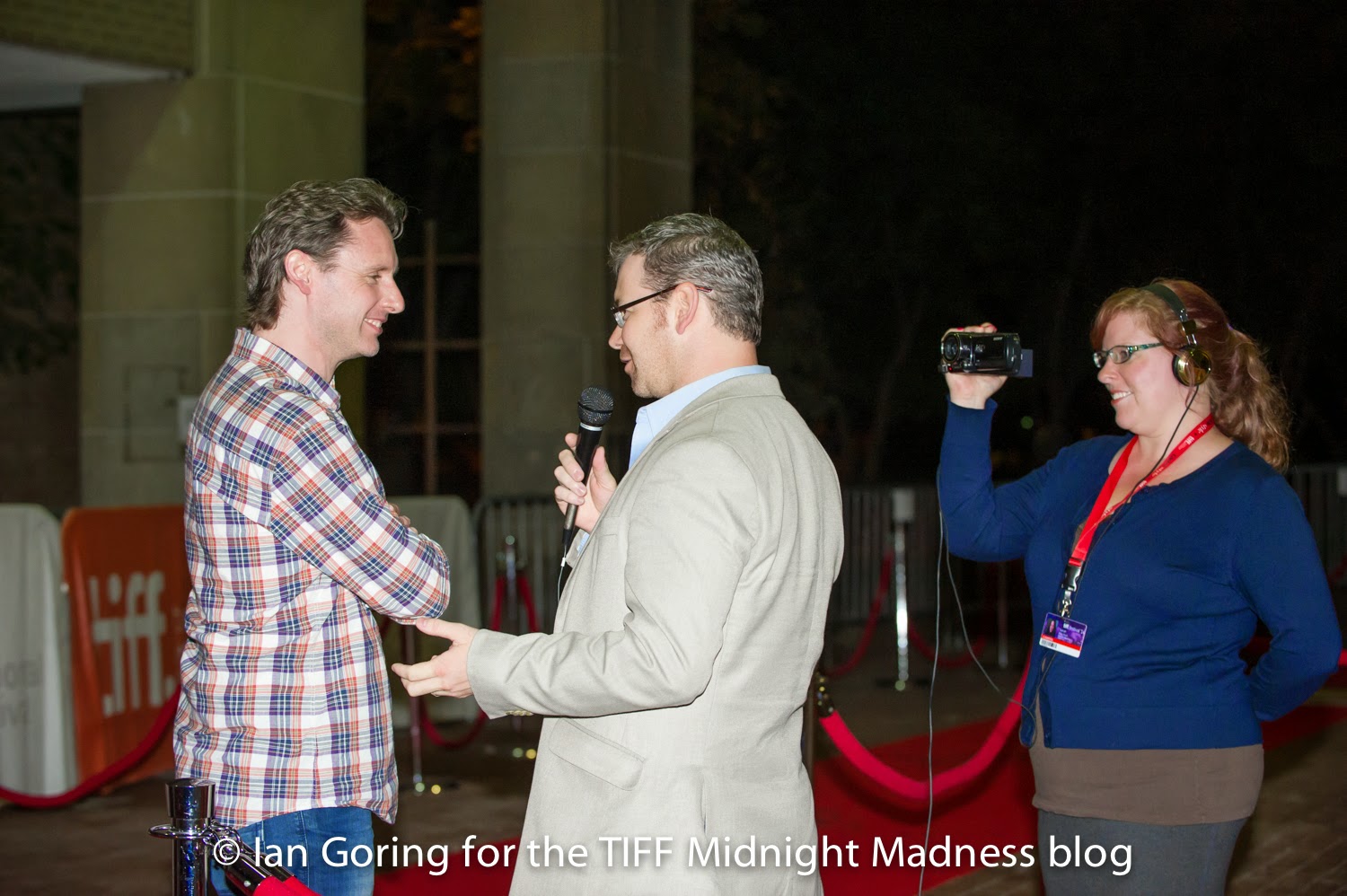
Robert was on the red carpet and spoke with Morgan about the film which Mr. Spurlock has described as a "horror documentary" Robert also spoke exterminator Ed Sheehan who has been in pest control for over fifty years. Here are those interviews. It was RATASTIC!
The In Light Human Rights Documentary film festival took place from March 5th to 7th in Bloomington, Indiana at Indiana University. Mala Mala was one of the films screened. The documentary takes a look the trans-identifying community in Puerto Rico.
I had the opportunity to speak with Jason Carrión who is featured in the film as well as his alter ego April Carrión, a drag performer who was featured on the television show, Ru Pauls's Drag Race.
The In Light Human Rights Documentary film festival took place March 5 to the 7th in Bloomington Indiana at Indiana University. Of the several films screened one of the highlights was Slums: Cities Of Tomorrow. Over one billion people on this planet live in slums. The film travels to several slums and squats all over the world. India, Turkey, New Jersey and Quebec to name a few. Many times these communities are looked at as the problem.
One of the major ideas in Slums: Cities Of Tomorrow is that we need to work with the people within these developments not against them. As the amount of space and natural resources on this planet continue to diminish we need to reevaluate how we all live together.
Nicolas Reeves is a researcher, artist, curator as well as an architect. He has a BS and a MS in physics from the University of Montreal and a MA in architecture from MIT (Cambridge). I was able to sit down and talk with Nicolas Reeves about the documentary and his ideas.
The In Light Human Rights Documentary film festival took place in Bloomington, Indiana at Indiana University March 5 to 7th. One of the films that was screened was Reportero. The documentary follows veteran crime reporter Sergio Haro and his colleagues at the news weekly Zeta. A paper based in the Mexicali region of Mexico.
The statistics are harrowing, according to Reporters Without Borders from the years 2000 to 2013: 88 journalists have been killed in Mexico with another 18 missing.
I had the opportunity to speak with writer and director Bernardo Ruiz about Reportero and his latest film Kingdom of Shadows.
The In Light Human Rights Documentary film festival occurred at Indiana University in Bloomington, Indiana March 5 to 7th. One of the films screened was The Case Against 8. The documentary which focuses on the court cases that argued against proposition 8. Prop 8 was a ballot initiative, and a California state constitutional amendment that passed in November 2008 elections which stated that "only marriage between a man and woman is valid or recognized in California.
I was able to sit down and have a conversation with Enrique Monagas one of the lawyers who was on the legal team representing the plaintiffs in Perry v Brown, the landmark federal lawsuit challenging California's Proposition 8.
As recently events have unfolded here in Indiana with Governor Mike Pence signing into law the Religious Freedom Restoration Act my conversation with Mr. Monagas seems even more timely and important as people across the United States continue fight for equality.
Robert A. Mitchell talks with director Mark Hartley at the midnight madness premiere of Electric Boogaloo: The Wild, Untold Story of Cannon Films. Also interviews with actress Robin Sherwood (Death Wish II) and Richard Kraft who was the head of music Cannon Films.
Last night I saw this years Academy Award Documentary Short Subject nominees. The films were as diverse as the human experience. Ranging from the story of the world's oldest holocaust survivor, to the documentation of protests in Yemen, an amazing story of forgiveness, to a cave digging artist in New Mexico and a World War II vet's dying days in prison. Suffice to say I shed my fair share of tears at these five remarkable and gut-wrenching films. I really have no idea how someone can vote on which film is better then another film. I would vote with my heart, however the problem I would face is that my heart was moved by all of these films.
The first film was The Lady In Number 6: Music Saved My Life. In this documentary directed by Malcom Clarke we meet Alice Herz Sommer who at 109 years old is the world's oldest living holocaust survivor. Listening to her remarkable stories and wisdom felt like listening to my grandmother. Her live is a testament to survival, life, positivity and the power of music which she describes as, "Music is dreams, music is God."
Karama Has No Walls screened next and tells the story of a peaceful protest in Change Square that took place during February 2011 in Yemen. The demonstration was peaceful and turned extremely violent when pro-government thugs arrived at the square. The footage in the film is culled from the cameras of Nasr Almamir age 17 and Khaled Rajeh aged 23. The footage is raw, gritty and on the ground. At one point there is blood on one of the videographers camera lenses. I have been a videographer for many years and have been at several protests, with that being said my experiences in protests with a camera pails in comparison to having people throw rocks, and having snipers shoot at you. I think anyone who is out in a violent public domain armed only with a camera is much more courageous than a solider protected in body armor and holding a machine gun. These young videographers need, determination in combination with their extreme bravery and great spirit to document the truth during these unfolding protests turning violent with little regard to the danger they are putting themselves into is true fearlessness. I am simply in awe of them.
Tim first met Matthew in an alleyway in Hollywood. Matthew who was a Nazi skinhead proceeded with thirteen other skinheads to brutally attack Tim based on the fact that he was gay. 25 years later they would have a chance meeting. Facing Fear is a phenomenal story of forgiveness and the ability of people to change.
CaveDigger directed Jeffery Karoff takes us to Northern New Mexico. In this film we meet the artist Ra Paulette. Ra does not write poetry or paint on canvas, his art involves heading out into the harsh terrain of New Mexico with a shovel, a trawl and a wheelbarrow. Ra digs into the earth and creates his own caves. I cannot describe how breathtaking his work is. For many years his cave digging has been commissioned art but as he comes to terms with the fact that he his aging and cannot continue this type of physical work for much longer Ra is trying to find and complete his magnum opus.
The last film of the night Prison Terminal: The Last days of Private Jack Hall tells the story of Mr. Hall who received three medals from WW II fighting for the U.S. As we meet Jack he is nearing the end of his life in an Iowa State prison. Many years earlier he was sentenced to life for murder. Jack is now 82 and is dying. This particular Iowa prison has a unique hospice program that sees fellow prisoners help care for their fellow inmates. One can be quick to judge someone's actions especially in the case of a murderer, watching this documentary does not make our natural instincts to rush to judgement very easy. Can people change? Does a convicted murderer have a right to die with dignity and care? This film affected me very much emotionally. Life consists of many layers and complexities. There are no easy truths. Our experiences consist of many colors and gray seems to be one that always floats in the middle. I am often wary of beliefs because to entrench ourselves and chisel our thoughts so deep into metaphorical stone feels to me that we are relinquishing on the human spirit and giving up on how much any of us can transform in a lifetime.
I want to congratulate all of the documentary subjects and the filmmakers for bringing these truly moving stories of people to life.
My recent research into Gordon Parks found me having the good fortune to meet director and editor Nicholas Eliopoulos. In 1968 he was a student at the university of Kansas and visited the Fort Scott, Kansas set of The Learning Tree as a student reporter. After that experience he was inspired to set out to Los Angeles to begin inroads towards starting his own career in the film business. He has been a an editor since the the late seventies and has directed four documentaries. Most recently, Mary Pickford: The Muse Of The Movies. Here is my interview with Mr. Eliopoulos about the film.
What was the impetus that made you want to decide to devote a significant amount of time to create the documentary on Mary Pickford?
Well, when I went back to a reunion in the late 80’s at the University of Kansas, there was another fellow who showed up from a class “way” earlier than mine.He was Charles Buddy Rogers who had starred as a young actor in the first movie to WIN the Best Picture Oscar WINGS – 1927. Buddy was Mary Pickford’s third and last husband, and even through Mary had already passed away, Buddy invited me up to his home Pickfair Lodge when I returned to Hollywood, and there were all of Mary’s Oscars, memorabilia and great collections she had gathered during her life and movie career.
At that time I knew very little about Pickford, only that she was a silent actress… as I became friends with Buddy, he lent me many of his and Mary’s films to watch. When I learned that Mary had purchased the rights to almost all the films in which she had starred, and they were housed in the Pickford vaults in Hollywood. I began to realize no one at that time had done a comprehensive documentary on her enormous contribution to the Cinema as a whole. The more I learned the more it fascinated me. My first interview for the documentary was with Buddy. He introduced me to Lillian Gish (Mary’s best friend and fellow actress) who was still living at the time. Lillian gave me a clip of film she had done mentioning Mary. So that began my collection of footage…. Almost 15 years later.. this is the final film you have just seen.
I understand that the process took almost two decades, could you talk about some of the challenges you faced trying to create the film?
The largest challenge was finding the funding to complete the project. Buddy and the Pickford Foundation helped with his initial interview, and then I spent almost 5 years looking for a funder (movies about the silent era at that time where not a sure bet for documentary funding). After many searches and false starts, I found Elizabeth Wood Coldicutt, my fellow producer, and her husband Thomas Coldicutt who served at Executive Producer.
We did several additional interviews with Douglas Fairbanks, Jr. and, in a fluke visit to Las Vegas, I was able to locate Roxanne Rogers Monroe, Mary Pickford’s adopted daughter and conduct the only “on camera” interview she had ever given about her mother. Roxanne has since passed away. For various reasons, some financial and other unexpected events, my work with the Coldicutts had to be put on hold for
almost 4 additional years. I had been searching and collecting footage and Mary Pickford audio interviews during the down time as well.
Then in 2002, we started on the documentary again, with additional funding, only shortly after that to have Elizabeth and Thomas suffer the tragic loss of their only daughter at the young age of 17. Elizabeth could not work for almost two years while she healed from the tragedy. She has since become stronger and started a Foundation for the Arts in honor of her daughter Caroline Victoria Coldicutt to whom the film is dedicated. You can visit her Foundation’s Web Site: http://www.cvcartsfoundation.org/ When we got rolling again in late 2005, we were able to complete this extensive work.
The film also serves as Elizabeth’s Master’s thesis in American History. We were accepted and premiered the film at the 2008 Telluride Film Festival, and then were invited for its European Premiere to the Pordenone International Film Festival in Italy later that year. In 2009, we had our Los Angeles Premiere at the Academy of Motion Picture Arts and Sciences Samuel Goldwyn Theater in Beverly Hills. Ms. Pickford was one of the original founders of the Academy itself.
One of the great aspects of the film is how you incorporated Mary's voice along side Michael York's narration. Could you talk about the process of tracking down the audio clips. What condition were they in? How much work did you have to accomplish to ensure they would be of a good audio quality? Could you talk about the process you had to undertake to "clean up" the sound?
Long before I began the film, I was on a trip to London and ran into Kevin Brownlow in the lobby of the BBC one day. Being a fan of Kevin’s many books on the silent era; I told Kevin that I was up to raising funds to do a feature documentary on Pickford. Kevin told me that he interviewed her in the late 50’s and recorded the interview on an inexpensive home recorder. I asked him if I could listen to the interview.
Months later Kevin lived up to his promised and about 5 cassette tapes arrived to my house in LA by mail. As I listened to Kevin’s interview, and how business savvy Mary Pickford really was, and also how well she expressed herself (even though the recording was very low volume and had other people talking in the background) it gave me the idea “why not have Mary, herself, tell her own story”. Kevin had only made the recording for information purposes for his book “The Parade’s Gone By”. He never intended to use the recording as it was of such poor quality. Kevin’s initial interview with Pickford sent me on a quest to find other audio recordings where she talked about her career and the beginnings of the film industry.
I went to the Library of Congress in Washington and found several radio shows. Elizabeth, Thomas and I traveled back to London where we found more recordings in the BBC Archives. Then we traveled to Paris and visited Charlie Chaplin’s Foundation where we discovered some gems. Other audios came in from Australia, some from Mary’s own vaults. I went to the George Eastman House in Rochester New York and found an oral history that George Pratt had done with Pickford. And finally Professor Arthur Freidman at UCLA had also done an oral history with Mary as well as interviewed her for his radio show. I spent an afternoon with Professor Friedman and he kindly gave me his radio show to use in our film. Now the hard part was balancing, restoring, and equalizing all the many interviews to come as close as possible to making the differences unnoticeable by the viewer.
I had worked with the sound guru at the Post Group in Hollywood, Steve Michels, before on a documentary I had done on the history of Russia. Steve is amazing in sound and music, and the mixer Troy Smith is the best in the business! For sure! Troy mixed and equalized the tracks. Mary’s voice was higher when she was younger, and as she became older her voice dropped almost a full octave. All that technical part was difficult and time consuming but paled in comparison to editing and ordering the sound bits and her many interviews so they “told the story” of Mary and the Cinema. I think had I not spent years as a film and sound editor in Hollywood, I could have never achieved the great task of having an actress (no longer living) co-narrate and tell her own story. It was a grand feat accomplished in the editing room and took quite a few of the 15 years just to get that one aspect done.
The amount of archival footage you also compiled is mind-blowing. This had to be a daunting task.
Where did you start compiling the footage from?
Again, almost close to 50 percent of the footage had been collected by Mary herself, in her own vaults at the Pickford Foundation. She was an avid fan of the movies, and oddly enough went about buying up the rights to ALL her own films with the idea she was going to have them “burned” upon her death. She was deeply afraid that future generations might laugh AT them rather than WITH them, and she didn’t want any kind of ridicule of her “little girl” or the “silent era” to happen.
When sound came in it left a deep mark in the psyche of those professionals who did not make the transition to the new medium, and with the change in projector speed from 18 frames per second to the sound standard of 24 frames per second, now all these great silent stars of the silver screen were projected faster which made them look like cartoons characters rather than stellar performers of the early art form. Mary was determined to have them destroyed rather than have them become a laughing stock. Thank goodness at the funeral of the great D. W. Griffith, Mary shared her plans with her dear friend Lillian Gish who talked her out of the idea. Now they are all donated to the Library of Congress and the American Film Institute as a record and preservation of an era gone by.
What did you learn about Mary Pickford that you did not know before you stated the research for the film?
So many things, well for starters, America's Sweetheart and the first female movie star of the cinema was actually Canadian. Mary Pickford was born in Toronto and proud of it. Mary was the first actor (male or female) to ever have her name in lights on a Cinema Theater Manqué with the Film’s Title.
Mary Pickford was the only star to ever receive a 50% profit share of her Movies. She was a founding member of the Academy of Motion Picture Arts and Sciences, and a co-founder of United Artists’ Studios, which was the first company ever owned and run by actor themselves. She created the Motion Picture Country Retirement Home to care for the aging of the movie industry, and even invented the “baby spot” lighting technique that is still in use today.
It was Mary Pickford’s idea to have “hand and footprints” outside the Chinese Theater in Hollywood, and with her then husband, swashbuckling hero of the screen Douglas Fairbanks Sr., the duo were the first to immortalize their prints in that theaters cement.
Mary starred in over 52 feature films, and 141 shorts, producing over half of them through her own Company. She was perhaps the most powerful woman in early motion picture history and that was long before there was television, and even before there was radio.
There has never been someone quite like Mary Pickford. She was a shrewd Hollywood pioneer and business woman at a time when there were only men attaining such heights in this new emerging industry. That was just a few things I began to learn as I looked into Mary’s life and career.
The film has been on the festival circuit and has won a lot of critical praise and awards. What is the future of the film? Do you have distribution?
Right now we are negotiating with several distributors to put our film out to into the world. We have a top notch Web Site: www.marypickfordthemuse.com, and we are going to put out a “limited edition DVD” on our own which will benefit the Caroline Victoria Coldicutt Foundation, and the sale of a “rose” Elizabeth developed in honor of her late daughter, The Caroline Victoria Rose: http://carolinevictoriarose.com/
You will be able to order our DVD on line at our Web Site: www.marypickfordthemuse.com and can
go there now to sign up under “contacts” to be informed of its release.


.jpg)