Death of a Yellow Bird is about to have it's world premiere at Fantastic Fest 2026. Written and directed by Cody Calahan (Undertone)
After
refusing treatment, a terminally ill man returns to his childhood home
searching for closure. While there he discovers, buried in the earth,
the family’s long lost VHS camera. Inside the camera he finds a video
tape of home movies. But as he watches, something disturbing begins
bleeding through the static. And before long, a disembodied voice. At
first, he suspects it’s his medication, but soon discovers a lurking
presence, turning his isolated childhood home into a waking nightmare.
With his days numbered and the hauntings escalating, he must solve a
dark family secret before his past consumes him.
In the far future, in a sterile world without nature or animals, Pasi (Miro Lopperi), a lonely designer of synthetic pets, unexpectedly discovers the last surviving squirrel. He decides to defy the rules and keep it alive, but things don’t go quite according to plan: the squirrel gets depressed, Pasi falls in love, and his carefully controlled life begins to unravel. The Squirrel is Finland's Official Entry for the Academy Awards Best International Feature Film. Here is the trailer:
Degrassi: Whatever It Takes has it's Toronto International Film world premiere today. Here is a trailer that just dropped for the documentary. Check it out!
Did you encounter George Orwell’s writing before deciding to make a movie about his life and work? Did you read him directly, or had you already absorbed some of his ideas through popular culture, or thinkers working under his influence?
Of course, if you have gone to school, if you have gone to university, then you have to cross paths with George Orwell. That’s obligatory. I grew up in many different countries and in each of them, Orwell is (was) a known commodity. But, politically, there were more important thinkers in my life, especially coming from the Third World. My political focus was rather about the North/South axis and tensions than the West sulking on its own problems. I probably had some suspicion towards Orwell over time. When you talk to people on the left specifically, some had a troubled relationship with his political evolution. He was suspicious. Before I started this project, I talked to two writer friends—both very famous, I won’t name them—and asked them if I should make a movie about George Orwell. One of them is British, a Marxist, still very left wing. The other one is American. One said that I shouldn’t do it, the latter, amused, was looking forward to my take. These are both people with whom I share certain experiences and positions, so it rather energized me. And now, more than ever, I feel very much closer to Orwell’s way of thinking—his autonomy of thinking, outside of any sort of dogma.
Resisting dogma is a major theme of his work, which is why it’s interesting that some critics are dogmatic about him: his politics, his ideology, his affiliations...
Well, everybody has claimed Orwell. And there are many instances that he would have disagreed with. Like the CIA, which put a lot of money into the first film production of Animal Farm. For them, that book and “1984” were perfect propaganda that could be used against the Soviet Union. Even though Orwell did use extensively Stalinism as the central vehicle and inspiration for these books, but he was not strictly referring to what was happening in the communism countries in the east. They were only very potent examples. Orwell’s analysis and criticism was not exclusively towards the East. He was also talking about democracies everywhere on the planet. He was talking as well about England and other European countries. As he wrote: “But to be corrupted by totalitarianism, one does not have to live in a totalitarian country.” People tried to fit his work towards their narratives during the Cold War, but they did it using one small part of who he was.
Your film deals with Orwell’s writing and his biography and how the two are linked; the impact of growing up in India and observing imperialism first-hand is significant. The photo of the infant Orwell being held by his Indian nanny is striking and very resonant—you use it to bookend the film, and to draw out a number of different ideas and meanings...
That photo became something of a reckoning for me. I thought: ‘Oh! Orwell is a brother. This is somebody from the Third World!’ If you grow up as a child in the Third World, it changes you and your view of the world. You can ask any “westerner” who grew up in Africa or in India and their view of the world have turned either totally racist or genuinely universal. That was a starting point for me. I was working on my film about Ernest Cole, and there was a sequence where you see these nannies in South Africa—Black nannies taking care of white, blonde children. You understand the absurdity of racism when you see how those white parents would hand the most valuable being in their lives—their child—into the hands of people they totally despise, people who they consider as basically animals. How totally fucked up is that? One of the nannies says in the film: “I love this child, but I know when she grows up she will be just like her mother”. This picture of Orwell with his black nanny connected me with him: he just turns out to be a fine human being. The interpretation of this picture at the beginning of the film differs from the one at the end of the film. It’s the same photo but it means two different things. At first, we see it and think. That fragile child with his black nanny. A uniquely warm, innocent and exotic childhood. And then the second time, at the end of the film, it’s scarier. You think ‘Oh my God... That woman would have every motive to just strangle that child’. There is a sense of unease and panic. It’s as if the whole history of the world hangs on the nanny’s ability to be a correct person, not to violate that trust and that original bond.
The image of Orwell’s birth rhymes with what we know about his death; the disease that rendered him weak and helpless. That feeling manifests in 1984, in the scenes of Winston’s torture and degradation, the way he is infantilized by his tormentors...
I knew from the start that I had to find a human and emotional point of entry to Orwell’s life and work. I had to find his “boiling point”. That point is more often than not the birth of something original, bold, determining to start threading a narrative. I don’t make biographies; I choose a moment in the life of a character that allows me to tell the bigger story. For Orwell, I found that moment quite rapidly. It is the last year of his life. At that time, he pretty much can guess that he doesn’t have much time to live. He's struggling to finish that novel that will make him famous and that he will not even live to see. He died four months after releasing 1984. He will never know the impact of that novel. The dramatic undercurrent of the film tension and dialectic lies on this state of his life between life and death and the struggle of finishing his “last” novel.
Do you feel that you came to understand Orwell as a person as well as thinker while making this film?
I think I did not only understand him as a writer, a thinker, but also as a human being. Without that, I don’t think the film would have made sense to me. Even in terms of how I see the world today, this understanding was key.
At the end of 1984, Winston mentions the proles, which is not just the proletariat—it’s something bigger. It’s the whole planet, including the “Third World”. And I am trying to reclaim Orwell for that third world, for my side of the world. Just as I cannot make a movie about a writer or a thinker whom I do not fundamentally understand and whose work I respect. I did films about James Baldwin, Karl Marx, Patrice Lumumba—people I understood profoundly. I knew their fight, their conflicts, their demons even that fueled their bold and unique undertaking. With Orwell, it was the first time I was going into a film without a deep personal connection to the subject, but I was able to find my bearings very early on. As soon as I re-read this incredible and lesser-known essay entitled “Why I Write,” I knew I was there.
You quote more extensively from “Why I Write” in your film than any other piece—more than 1984, even.
That text is him. It’s all of him, it’s a confession. It’s an act of contrition. He’s not hiding anything, “...I was part of the actual machinery of despotism”, having “bullied” the natives and even hanged a few, his despise of his own social class and the classes above, the hardship of imposed poverty in London and Paris, to experience “reality”, etc. You see the man, with all of his flaws. It’s not a lecture; it’s about putting a mirror up to his own face. That idea of the mirror—that’s something else I want people to understand. I have a lot of trouble every time I hear columnists talk about “dystopia” or calling him a “prophet.” He was of course not a prophet. He was talking about the world around him. It’s not a projection, it’s an analysis. He’s working through it all: what he went through in British Imperium; what he went through in the Spanish Civil War, what he experienced in England, in Paris etc. He’s analyzing the early days of the Cold War. It’s not prophecy. It’s the world as it is, as he was living it.
What do you think differentiates Orwell’s analysis from later generations of writers?
The way I see it is this: in the 1970s, most serious writers needed to have a tremendous amount of general knowledge—about poetry, about history, about culture, geography etc... It was not as much about their inner lives or “feelings”. Inner life was the fuel, the Zeitgeist they used it to power the rest. The recent decades, through what we could call a “democratization” of culture, and concurrently the focalization toward “the inner self”, almost anybody is entitled to write. Any experience is allowed to be printed and commercialized. You don't need the more general deeper knowledge of the universe above you nor the idea of the “collective “. You no longer must refer to the world around you. You ARE the world (or it revolves around you, personally, intimately). We have lost the collective mind. We have lost the collective fight. I can see it in the generation after me. Nobody thinks about death the same way today, about risking one’s life for a cause. When I was studying in Berlin, I knew that I was going to go back to Haiti and die. My friends from South Africa, they knew they were going to go back to South Africa and die. My Iranian friends knew it, my Nicaraguan friends, my Brazilian friends, my Chilean friends. We all knew.
We didn’t talk about personal faith so much or about personal struggles or feelings (Not that it was a good thing. On the contrary. But it was just not proper). When the Berlin Wall fell, there was no stopping of the exuberant capitalism cries of victory. Capital had won. And so everything else that came with it. It was a complicated world, and we needed writers with a wealth of universal knowledge who could help us understand the moment beyond the allegorical Fukuyama’s “End of History”. But on the contrary, we went for full blown fragmentation, specialization, and individualism, inner soul and self-wellness among other developments. And this is in every field of all society, media, academia, politics. We lost the collective, the overall analysis. Everybody focused just on what they could chew and got lost in petty details.
In some ways, the right wing—at least in the West—has done a better job capturing the collective imagination, in politics and in popular culture as well.
It is always easier for those forces because they don’t have to care about the multitudes, nor about the truth or the nuances. They just have to care about their profits. Capital not only has no frontier, but also tends to control politics, through different tools and procedures. To a point where any powerful president, at least in western democracies, merely has a negotiation power. We can see how President Obama, besides having inherited one of the major capitalistic crises in history, still was under the sway of the Wall Street power brokers. Every move or economic decision was the result of heavy discussion and compromise, in which more than once, banks and industry well-being were privileged over citizen interests.
Authoritarian regimes operate with less moral qualms and restraints. The ending of A Face in the Crowd comes to mind — except that instead of being exposed by the television cameras, authoritarian leaders are emboldened by them. There is no limit. If you just let it go on there is no ending.
In Germany in the 1930s, Hitler took at least six, seven years to become Hitler. The establishment thought that they would “control” him at the end. He had written out what he was going to do in Mein Kampf. And nobody took that seriously. It’s the same with Project 2025. At what point do you start to take warnings seriously? Bullies, authoritarians—they have no limit. It will get worse and worse until they are stopped. It's not right against left now. It’s an authoritarian regime. It’s Big Brother. It’s the same with authoritarian playbooks today, in many countries. The names change; the goals don’t. They target institutions, courts, media, civil society. They follow the same script as abusers: isolate, humiliate, intimidate. They’re predators. And unless stopped, they escalate.
I grew up in many different dictatorships. Whether it was Haiti, or whether it was the Congo... we could feel early on when something was going wrong. It’s when people cannot speak their minds anymore, when you must think twice before saying things in public, or addressing certain topics. That’s what dictatorship is. It’s little by little.
Did you know at the beginning how much contemporary politics in general—would be threaded through your portrait of Orwell?
That all came very quickly when I went through “Why I Write.” I wrote a one-page summary for our investors, and the film was all there right from the gate. Except that I didn’t realize at first that it would go so deep and dark and morph so close to our reality. When the project was proposed to Alex Gibney and then myself —we knew that we couldn’t say no: we were being offered access to everything Orwell had written. The same access I had gotten with James Baldwin’s body of work, who, as I said, was closer to home for me. When you have that kind of access and you don’t make a great film, you’re in the wrong line of work. With Orwell, it was also a once in a lifetime opportunity. What I knew I needed to find was the connection to the world I’m living in, and that’s what I mean when I say Orwell is a “brother”. He saw the world in a way I can relate to. I had my share of Big Brothers throughout my life. In my youth, the U.S. was supporting dictatorships in Haiti, killing Lumumba in the Congo and staging numerous coups in foreign countries. And Newspeak was always part of my reality. When they say “democracy”, it was never meant for the likes of me. I grew up with Newspeak. I grew up with Big Brother. In the Third World, we all grew up in the shadow of Big Brother.
The language of euphemism is another major subject in the movie; it’s the language of corporations, a sort of airbrushing of agendas, the rhetoric of hard-sell advertising.
It's corporate, it’s political, it’s military. All of it. As a Black person, my life is about deconstruction. Why do we deconstruct? Because we know that what we are seeing is not our reality. We grew up deconstructing Hollywood films because we knew that when we were seeing Indians being killed by cowboys, that they were us. To enjoy the film, we had to deconstruct it, to make it accessible (or acceptable) to us. The ironies and contradictions were obvious. Hollywood was never a “dream” for us. We grew up with that dichotomy. The movies were Newspeak.
Because American movies are so big and expensive they can be hard to deconstruct. They’re made to be solid, to be impenetrable. They’re weapons of soft power.
That power was never totally “soft” for us. The traces linger for very long. Soft power is never innocent. If you live in the West, there’s no need to deconstruct that power. That's the privilege that you have: you don't have to. Elsewhere, if you don’t deconstruct that power, it will kill you. For a more profound and definitive analysis of this, and way more eloquent than me, I would recommend The Devil Finds Work from James Baldwin. That’s what James Baldwin said about Hollywood in The Devil Finds Work.
Baldwin’s profile has been raised in the years since your documentary. There were two different movies this year—Eddington and Sorry, Baby—that used him as a reference or a signifier, and of course there was Barry Jenkins’ adaptation of If Beale Street Could Talk.
Yes, Baldwin is back, baby! As he should be. And I am glad that a whole new generation is reappropriating his work anew.
When Barry Jenkins made Beale Street he invented a new genre, a new way for black actors to work and play their parts. I have worked with black actors for forty-five years, and I can see how Beale Street was a successful attempt to propose something new, that is not a cliché. American movies reproduce cliches over cliches over cliches, sometimes ironically, sometimes not. [Jenkins] succeeded in finding a new way for actors to show emotions, to show pain, to show joy, to show love.
Is it fair to say that more movie critics have read Orwell than Baldwin?
By the sheer mathematical reality, it is evidently true. But I'm not sure that many more now have read Baldwin, if it is only to keep up with the flow.
That being said, I am sure most know about Orwell as “the prophet” rather than somebody who is actually writing about the real world. The thing about Orwell is : everything he wrote, he went through himself. The editing of the movie tries to reflect that. We can see how the physical reality of his illness—his tuberculosis—finds its echo in the rendering of Winston in 1984, where the motif of the ‘lungs’ recurs throughout. We can also observe how Orwell’s own complicated behavior with women is mirrored in the strange, often uneasy and sometimes disturbing dynamics of Winston’s short-lived and tragic relationship with Julia (‘Do it to Julia, not me!’).”
He could be an awkward man in real life. He was awkward with women. With his last wife, Sonia Brownell, he asked to marry just a few months later after meeting her although his health was already severely impaired. I can hardly believe that he was even in love. His work was his life story. He could only write about things he went through. If you read 1984 as a prophecy, you will really miss out on Orwell's essence.
There’s something adolescent about Orwell: a sense of idealism that never faded as he grew older. It’s also palpable because he had such a short life.
The adolescence you’re talking about is only possible in the West. Because you can afford to be a fully grown adolescent in the West. Orwell, protected himself from that delusion through humor, sometimes even through cynicism and wit. His distinctly British sense of distance probably saved him from despair. Because he “knew” and could not “unknow” what he had seen.
How did you go about organizing the material in the film?
My job is to find a way to make a movie that’s accessible for everybody, not just for literary savvy people. We read everything—everything that Orwell wrote and then I started to make selections from the text. I knew that I had to come up with a sort of libretto, the same way I did for James Baldwin. Making a film is obviously not like writing a book. It’s closer to the way you might write an opera, except that you’re using somebody else’s words. Orwell’s words are strong. I have to be careful though to not twist his words. My work on Baldwin did help me a lot. His humanity was closer to me and easier to handle. Orwell is more... British. You have to find the emotion in it. We took a lot from “Why I Write” because it’s more sincere, human and direct— both about himself and about the society he is writing about. It's perfect material for a voice-over.
The movie includes footage of the war in Ukraine and Gaza; these are very charged images to put in a movie about a writer who died seventy-five years ago.
I’ve been making films for 40 years. All of the movies I’ve made are about alarming people to the state of the world. I’ve never made a film that I didn’t totally believe in. And making 2+2=5 was basically like watching the news. For example, I was re-reading 1984. At the very beginning, Winston is writing his journal: “April 4th, 1984. Last night to the flicks. All war films...”. Then he basically described how the coast guards are bombarding a boat full of refugees in the middle of the Mediterranean. Sounds familiar? This gives you the chills. You basically just saw that in the Evening News! Orwell is exactly what’s happening now. Even the audience’s reaction, us, sounds so familiar: We don’t care. Every day boats are sinking. Nobody stops it.
The Zone of Interest comes to mind—that vision of compartmentalization, of living adjacent to suffering.
I lived like that in Germany for fifteen years, in that state of mind. I talked about it in Exterminate All the Brutes. I’m Black, not Jewish, but the Holocaust was also my reality. I did my film school essay at Plötzensee, a Nazi torture chamber in the middle of Berlin. There is that phrase “never again.” People see it as a philosophical sentence, barely a warning nowadays. How many people repeated “never again” again, and again, and again. The same countries that were the “liberators” do this everywhere else. It takes different forms, but you know, it’s the same.
I’ve done several films about genocide, so this is not new to me. Orwell is just the latest one. People need to look at their reality. Consumerism has overcome the West while the rest of the world is looking. They know it’s all an illusion. That you are in a sort of a bubble.
There are refugees on every corner in Paris today, or in other European capitals, where people are just being pushed from one corner to another. Just wait for the next Alcatraz city. Yet, they are the ones doing most of the “second front” to use a covid popular term. Delivering food every day, working at meat factories, taking care of the elders, etc... they were dying by the hundreds during COVID. That’s the part of the world that’s watching the “opulent” West (of course we know that it’s not opulent for everybody). I doubt that they still believe in all those well-meaning words, like democracy, justice, human rights, etc.
In the film, you quote the end of 1984, the idea of a faint hope in the darkness. Do you think that hope is real? Or is it just another platitude?
There cannot be hope without understanding. Marx wrote the same thing: you can’t push people to the barricades if they don’t know what they’re fighting for, if they don’t understand the whole system and why it is making them miserable. You can go to the barricade and burn down everything out of anger, and then what do you do after that? You still have to rebuild something. It can’t just be Christian hope—the hope that “it’s going to get better.”
Maybe it’s not hope we need; maybe we need reality. We need to cease just being consumers. We even consume democracy! We choose for whom to vote like we choose a soap bar. “Let’s try this one this time.” It’s consumerism.
What I know for sure, history doesn't function with “hope”. If you want change, you need to act upon it. If we just stare, it will just be somebody else’s plan.
There are people who really do believe that 2+2=5, of course. And others who may not believe it, but find it easier to say it.
Some people may believe that, but I don’t need to indulge in their craziness. In the beginning of the film, there is a clip of Orwell with his son Richard as he advises him: “always know that two and two are four.” Some people will tell you that two and two are five. They are called governments... big corporations. ...They will torture you... they will bribe you... etc...” In hard times, we need to have the courage to say that: “Two and two equals four” That’s what the film is about.
OCA is having it's world premiere at the 2025 Toronto International Film Festival. Here is the festival poster and trailer. Oca is written and directed by Karla Badillo.
Robert Aaron Mitchell deep in South Texas filming a rattlesnake for his next film. (Do not attempt this at home)
"I am making something vastly different than The Bobby Diamonds Story) I am an American living during this time in America. I have a lot of rage inside because of the fascism this country has become. As I say this another mass shooting has taken place. This time in Minneapolis. Year after year after year these tragedies occur and nothing positive has been done. Gun laws have gotten more lax as time goes on. This country is entering a period of severe instability. The civil war never truly ended. It has remained as embers of hate all these years later. We are entering another period of civil war. While this film I am currently mired in does not directly address these issues the film is serving as a primal scream and it would be naive to think my environment is not playing a role in my artistic endeavors. At the end of the day during the production and post-production phases on my new work I am striving to make a scary fucking movie."
The Bobby Diamonds Story now has a poster. The poster reflects the duality of a poker player as well as the duality of the story the documentary unfolds. The film also recently won Best Documentary Short at the Tokyo International Short Film Festival joining the film's win at the Venice Fullshot Film Festival.
Director and writer Robert Aaron Mitchell also recently did an interview about The Bobby Diamonds Story and film making in general. You can find that interview HERE The film's iMDB page is HERE
The Bobby Diamonds Story has begun it's film festival run. On September 5th the film won Best Documentary Short at the Venice Fullshot Film Festival. I am very grateful and humbled by this award as my short begins the roller coaster ride that is submitting to film festivals.
Underground poker player Bobby Diamonds steps into the spotlight in a hallucinatory, hilarious and heartfelt documentary. Here is the official trailer:
Today The Legend of Wasco gets out of it's tiny clown car and arrives in Redboxes, iTunes, Vudu, Xbox and will be seeing a DVD release January 5th, 2016. In June I traveled to Louisville, Kentucky to be a day player on this film. I play Detective Palmer.
A synopsis: Future brothers-in-law Tyler and Byron bond by dressing as the Wasco
Clown and taking pictures that spread across the internet, a viral hit
overnight. What starts as great fun turns deadly as the very real Wasco
Clown returns to terrorize the town. A tale of legend come to life, a test of the friends’ courage to overcome their fear of a circus nightmare, resurrected.
A lot of folks worked hard to pull this film off. It was co-directed by Shane Beasley and Leya Taylor who previously have worked on the films Found & Headless. The screenplay was written by Nathan Erdel who wrote the film Headless and produced by Scott Schirmer who wrote and directed Found. Here are a couple of stills from the film. Jason Crowe, Dan Nye, Jessica Schroeder play the leads in the picture. Brian Williams did the cinematography.
Here is the official teaser trailer for my short film entitled Sugar. Sugar is a Southern Gothic film centered around the title character played with great fervor by my niece. She was cast in the film based upon the above picture my sister took as well as her vivid imagination. Look for the finished film in 2015. Sugar is produced by Sarah Mitchell, Mike Scott and myself.
I love trashy cinema. Films that played at some run down second run theater for a night or maybe a week, a movie whose last stop on the circuit was a drive-in in Indiana. Movies that you cannot find a poster for while searching through images, a cast that may not have any imdb credits. Films with titles that are often preceded by aka.
We live in a world where all information is readily available everywhere and anywhere, we are always connected or so we believe. Recently I drove through the Great Smoky Mountains in East Tennessee and was thrilled to look at my cellular phone and see no signal. It is rare I find myself not connected to the web and that rare feeling of not being connected extends to these "trashy", "drive-in" or the now post Tarantino, Rodriguez everything that was low budget, cheesy, or any kind of genre movie now becomes a "grindhouse" film. Movies that no respectable connoisseur of cinema would ever embrace, the kind of movies that drift through bargain bin to bargain bin, one small film company to another distribution company, movies that wind up in a pawn shop or a thrift store with several price tags on the box. Which brings me to Lexington, Kentucky.
I was recently in a Half-Priced books in Lexington and came across the Mill Creek Entertainment 32 Drive-In Cult Classic Movie Collection for a price that would average around fifty cents per film. A small price to pay for cinematic lost treasure. As I watched the first film according to the back of the DVD box was entitled Blue Monday (1972) -- which once I put the DVD in -- I learned that the film was actually called Blue Money about a pornographer who is just trying to get by in a cruel business, it struck me that I should write a few things about these films. Why not? I'm not adverse to write about movies. It's just in this Internet information overload age who really gives a fuck what I write about films.
So here it begins, a few thoughts about a film called Double Exposure (1983) -- at least according to the good folks at Mill Creek Entertainment. Also according to those magical all seeing and all knowing gurus at imdb this film fuses together not one, not two but four genres. Comedy, Crime, Drama and Horror. I dimmed the lights and poured a glass of O.J. and prepared for the journey that lie ahead. It begins with a credit sequence that is so outstandingly annoying, so much so that I thought that perhaps the orange juice I was drinking was spiked with some hallucinogenic drug and that the trails I were seeing were not in fact the movie but were my own vision. For a film about a photographer and images I thought this was brilliant. Fuck up the audience early and keep those fuckers unbalanced.
When the Director of Photography credit came across the screen with a shot by the camera operator unable to keep up with an overhead shot of a sports car I knew this film had already endeared itself to me. The film centers around a photographer Adrian Wilde played by Michael Callan who has problems. So much so that when we meet Adrian he is on the couch in his shrink's office. "Every time I'm turned on and the chicks aren't and when they're turned on, I freeze. Every time I think I'm getting better I slide back." and that's just artistically, what about the dreams? "What dreams? The bizarre, crazy dreams."
Adrian may indeed have problems but picking up chicks ain't one of them. He is one smooth-talker... the title may be Double Exposure but the dialogue is pure double-entendre. Watching this film I thought to myself that watching a person go absolutely bat-shit crazy to the point that they may indeed be a serial killer is by a far a great cinematic device. Which makes me pose the query, "What makes good cinema?" Well according to Bill Yates an associate professor at Saint Joseph's college in Maine good cinema can be thought of as such, "If you can engage a person ... then it's great film." Which brings me back to Adrian our hapless photographer suffering from dreams that may or not be real and this movie Double Exposure, which is a compelling, engaging narrative and for my money becomes pure cinema.
As the film unfolds and the ominous music swells our photographer's grasp on sanity and reality begins to slip. What follows is a pretty decent thriller. I really enjoy films that play with the reality of the movie and folds into itself like an accordion. Director William Byron Hillman and Editor Lawrence Bridges do an admirable job playing with the dream and reality of the narrative.
Ultimately Double Exposure is a low rent Hitchockian, Depalma thriller that falls way short of the mark, but of course it falls short of the mark. Hell that's why I watched it in the first place. But where Exposure fails it also succeeds is a film with just enough sleaze, violence and nudity to ensure that in the early eighties it would be seen in a theater, than later the burgeoning home video market and eventually wind up on late night television. If the user ratings on all unknowing one-eyed seer of imdb garner any insight into the matter, you will either love this movie or hate it.
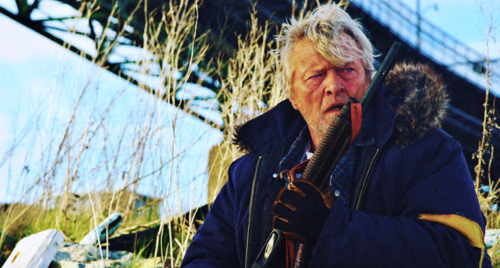
One of the films I have been tracking for quite some time is Canada's own Hobo With A Shotgun. It is quite a remarkable story. The initial trailer was made for the Robert Rodriguez' SXSW Grindhouse trailer competition.
Jason Esiener's trailer took first place. When Grindhouse played theatrically in Canada the Hobo With A Shotgun trailer was interspersed with the regular coming attractions. The trailer was so much fun and so true to the seventies exploitation trailers that it was not long before there was talk of a feature length version. At the 2008 Toronto After Dark Festival I caught up with director Jason Esiener and producer Rob Cotterill. We spoke about their short Treevenge that premiered as a part of the closing night festivities. We spoke about the possibilites of a Hobo feature, which at the time were in the very initial phases of going through the process of trying to find funding. Here is that 2008 interview:
Well the film was the opening selection of the Sundance Midnights programme and has been getting great reviews from a number of critics:
It has been quite fun to watch these guys and their passion for film take them from a trailer shot in Dartmouth, Nova Scotia to a feature length film starring Rutger Hauer. I send you guys huge congratulations and am glad the world is getting to see another side of Canadian cinema.


.jpg)