
On a quiet Sunday a week after the 2021 Toronto International Film Festival ended I was able to sit down over zoom with director and writer of Dug Dug, Ritwik Pareek. We had a great in depth interview about the making of the movie.
On a quiet Sunday a week after the 2021 Toronto International Film Festival ended I was able to sit down over zoom with director and writer of Dug Dug, Ritwik Pareek. We had a great in depth interview about the making of the movie.

By Carol Borden
Evan Jackson Leong Snakehead (USA, 2021)
Snakehead chronicles the life of Sister Tse (Shuya Chang) after she has paid a snakehead--a human smuggler similar to a coyote--to bring her to New York so she can find her daughter. Sister Tse is very practical about this arrangement, so practical she works her way up the ranks of the local family holding her debt and attracts the attention of gang matriach and community benefactor, Dai Mah (Jade Wu). Sister Tzu also attracts the attention of Dai Mah’s son, Rambo (Sung Kang), who is jealous of her relationship with his mother.
Snakehead is based on the true story of infamous leader of a human trafficking ring in New York, Cheng Chui Ping, aka, Sister Ping. And it is definitely a story worth telling. But no matter how much I want to see this story and I want to like it, Snakehead is uneven. It does not feel finished. It feels like maybe it needed another draft. On one hand, I appreciate grounding the film in the community and some of the strongest elements are related to that almost documentary feel. On the other hand there is also frequently awkwardness in line delivery. Sister Tse’s narration felt rote and didn’t create a smooth narrative flow between the segments we see from her life. It feels more like dramatized segments in a documentary about someone’s life. And this makes me think about whether Snakehead might work better as a documentary than a drama / action movie. But the thing is, I want the action movie that Snakehead is trying to be. The documentary would be interesting, but the action movie that shares this world and the lives of the women inhabiting it is an amazing vision.

And there are some real strengths in the film, Ray Huang’s cinematography for instance. Shuya Chang is charismatic as Sister Tse. Sung Kang is suitably frightening as the out of control Rambo. But Jade Wu steals the film as Dah Mah, bringing an outstanding depth to her character and a flawless delivery.
Snakehead tries something new in terms of story, and I cannot appreciate that more. I hope everyone working on it keeps working on getting stories like this made. Because even if Snakehead doesn’t entirely succeed, it’s a start.


At the genesis of SALOUM, there is the meeting of my partner in crime Jean-Luc Herbulot. We both had a visceral need to create works in Africa, filled with heroes and monsters. It was what we craved as kids to see coming from African film, so we created it ourselves. During a trip to the Saloum region of Senegal in 2018, we wrote the short story “The Twilight of the Hyenas” an African western... a horror film... a fantastic epic... an ode to the imaginary world in which we would like to stay and a furious artistic deliverance rather than a desire to fill an empty box.

The movie was filmed in nature, mostly in the mystical and wild region of Saloum, Senegal where my journalist father had filmed wrestling matches more than forty years ago and where my mother still lives; on an island without cars, far away from all levels of city life.

SALOUM is the first feature film from LACME STUDIOS, co-constructed with the actors and technicians, day-after-day for five straight weeks - the epic adventure of a group living outside the comfort of their respective homes, much like the hero-mercenaries of the film itself. The absence of a network, the random supply of water, the regular silting up of vehicles... blood was shed along with tears. SALOUM is the result of the talents we gathered who were kind enough to follow us on this adventure.
The production of SALOUM was a natural shifting of gears, the result of adrenaline rushes, soul encounters, inevitable pains, loves, the divine and fears of emptiness ... a birth of a bloody new-born already adored by its parents.

"When you want to succeed as bad as you want to breathe ..." Eric Thomas recounts in his motivational speech, explaining how an old man kept his student's head under water, thus demonstrating the true meaning of the word "motivation.” This best explains why I believed in this film, why I expected it and why I didn’t hesitate to take the risk.
It’s important for me to release African artistic madness, so universal and yet so rare on international screens.


What is your background as a filmmaker?
No film-school. No camera. Just an eight-year-old filled with feverish dreams. I am and always have been what I refer to as a hostage of creativity. As an adult, I finally found the outlet to release those dreams into visual stories.

What was your initial inspiration for making SALOUM?
A lucid dream and an experience of drowning. When I was a kid, 5 or 6 years old, in Congo, I was alone on the seashore, and I suddenly got sucked into the water. I fought my way back but remember losing it and just letting go... But then, I finally came out of it, like somebody pushed me back to shore. I remember being helped by an adult that was guarding me. This guardian said I had disappeared for more than five minutes. And she was not joking, she was crying and scared to death. That experience made me question about the unknown and perceptions. Later on, some years ago, I was in Dakar. I was pretty sick, feverish, but I won my battle against insomnia that night. I slept and had this weird dream of floating and being a camera in the middle of a gunfight, more precisely an execution. I witnessed a military kid going forward, gun pointed to his destiny/enemy? Who was that kid morphing into an adult? The rest is in the movie.

The performances in the film are exceptional– what was your casting and rehearsal process?
I don’t go through a traditional casting process I spend time choosing people I want to work with. We all lived together in the camp that you see in the film, so the tenderness and the tensions were based on reality. The performances in SALOUM are what happens when you isolate thirty people with a thirst for creativity in a contained desert camp, in a spiritually overloaded environment.
What are your cinematic and creative influences, and how did they influence the making of SALOUM?
Red Dead Redemption 2, the ancestral spirits of Saloum and “The Strummer’s law” – the idea that a constant flow of creative inspiration into one's life is as important as breathing.


By Carol Borden
Camille Griffin’s Silent Night (UK, 2021) was not the cozy British Christmas movie starring Keira Knightley I was expecting. Sure, it starts with a range of well-off couples singing along to a Michael Bublé Christmas song as they drive to a beautiful house in the English countryside. Tony (Rufus Jones), Sandra (Annabelle Wallis) and their daughter Kitty (Davida McKenzie), James (Ṣọpé Dìrísù) and Sophie (Lily-Rose Depp), and Bella (Lucy Punch) and Alex (Kirby Howell-Baptiste) all seem to be in good spirits as they reveal comedicaly charming little cracks in their relationships. But they are gamely trying their best for a Happy Christmas among old friends. And, sure, Nell (Keira Knightley) is madly trying to finish dinner in time for everyone’s arrival with the help of her son Art (Roman Griffin Davis) while her husband Simon (Matthew Goode) corrals their other two sons, Thomas (Gilby Griffin Davis) and Hardy (Hardy Griffin Davis), into the bath and lays down the screen time and swearing rules for the night. Of course, there are problems with dinner preparation. There are only enough potatoes for each person to have one. Nell didn’t get the sticky toffy pudding promised to Kitty this year. And Art cuts himself and bleeds on some of the carrots. And this is where little things start to accumulate. Nell is hosting a lot of people and can be hard to figure out how much food is enough for 12 people, including four tween or teen children. But why doesn’t she throw out the bled upon carrots? Why do her friends still eat the raw carrots after seeing some blood on them? And when Sandra and Nell send Simon and Tony to the store for sticky toffy pudding, why do they suggest throwing a rock through the store window?
Silent Night is not a cozy Christmas reunion in the country movie. A kind of movie that is beloved whether filmed in British Columbia for the Hallmark Channel or stars beautiful posh English people on the big screen. Silent Night is another entry into the genre of white people dinner parties--terrifying whether it’s just unpleasant interactions with awful people in many, many period pieces or the hosts are pleasantly planning terrible things, as in Adam Wingard’s You’re Next (2011), Karyn Kusama’s The Invitation (2015) or Jordan Peele’s Get Out (2017). This Christmas dinner is a danse macabre or, a la Boccaccio, a plague dinner. Old school friends with two “new” tolerated partners, Alex and Sophie, gather to celebrate one last time before the end. But the plague is not a virus or bacteria. It’s a toxic storm caused by climate change and everyone who has been caught in the gases spreading over the earth has died bleeding out their eyes. The house is beautiful, the wallpaper is worthy of Louis Wain, the friends are eating and dancing together, but the carrots are bloody and the poisonous storm is coming.
The friends gather together in the name of “love and forgiveness.” They also gather to explain to their children what’s happening. Or rather, they explain once they have to. As Sophie, interloping American partner of James the oncologist says, “Posh people like to keep secrets.” And because Silent Night is a comedy, a very dark one, Nell and Simon gather their sons to tell them, “We just want you to understand as your parents, we are not to blame. This is not our choice and this is not our fault.” But none of this goes over well with the children. I think Roman Griffin Davis’ Art will rightfully get a lot of attention, as will Davida McKenzie’s powerhouse performance as the imperious Kitty. But I just want to share my love of Hardy and Gilby Griffin Davis’ delivery as the very chill twins.
Silent Night is a comedy that involves a lot about class and maintaining appearances, both personally and socially. But I think it also deliberately subverts its characters belief that everything and everyone is kind of awful underneath--especially through the character of Alex, a black Lesbian observing many of the shenanigans around her and once using a Scrabble board to comment on secrets being revealed, before remarking to Bella in private, “They’re all so mean.” Alex has seen people not like Bella’s friends even in the world of Silent Night. And many of those people are out there excluded from the British government’s plan for dealing with the toxic gases.
Silent Night was absolutely not what I was expecting. I’m glad Robert Mitchell recommended it to me without telling me why. I do hope they include director Camille Griffin’s video introduction to the film in any video release. I am not sure many people will have that same experience of going in blind, because Silent Night is not a film to suggest to people who want to see a nice, cozy movie to enjoy over the holidays. It would be traumatizing. And a lot of people who would enjoy it might be put off by a Keira Knightley cozy Christmas movie. But I am sure whoever distributes it will find a way because Silent Night is a not movie that is ruined by knowing what it’s about, without knowing too many specifics of what happens. That said, there are some jokes I’d love to repeat here--especially one about The Road (2006). But I won’t. You should probably see it for yourself.

This is how topsy-turvy the world is. My final movie at the
2021 Toronto International Film Festival is a Keira Knightley Christmas movie.
One of the great things about attending a film festival, is to walk into a movie
theater or, as is my case this year - stream a movie - you have no idea about. This movie with a premise of a midnight madness movie was a complete surprise. I loved it.
It is Christmas afternoon. Nell (Keira Knightley) and her son Art (Roman Griffin Davis) are in the kitchen preparing dinner. Michael Bublé plays. It is a beautiful afternoon in the English countryside. Perfect. Peaceful. Art is cutting carrots and cuts his finger. Blood spurts all over the carrots.
Family and friends begin to arrive. Some eat the bloody carrot bits. They either do not notice or do not mind. The kids run around the house and get in each other’s hair. This leads to a lot, a hell of a lot of children profanity. It is stupid, fucking funny.
"Tonight is all about love and forgiveness." Nell proclaims to everyone who has assembled for this Christmas celebration. Tonight will indeed be about a lot of things.
Another common thread that I have seen with the movies I have watched this year the Toronto International Film Festival is great dinner sequences. You Are Not My Mother, Saloum, Unclenching The Fists. Silent Night also contains a dinner scene, and it is amazing and the centerpiece of the entire movie.
Dinner is served. There are hints that something far greater is happening outside this family Christmas dinner. The potatoes are rationed. One potato per person. A prayer is begun. It is awkward and funny. Nell contributes to the prayer, “To love we have shared.” The word, “have” hangs in the air. One of the guests Bella (Lucy Punch) looks out the window. Her look of nervousness is at odds of the beautiful blue sky out the window. The conversation turns to the Queen’s speech. "Well she is clearly in some bunker setup", says Tony (Rufus Jones). Nell quips, "If you want to live in a hole and eat dog food..." "It's fine because she's old" Kitty (Davida McKenzie) quips.
The dinner conversation gets even better when Art brings up Greta Thunberg. Roman Griffin Davis and Davida McKenzie play exceptionally well off of one another. Sofie (Lily-Rose Depp) begins to expound upon the difficult night she had last night. The adults are trying to change the conversation but the kids want to hear more. "We had dinner, sang Celine Dion, dance to Brittney, laugh, cried..." Sophie gets out before the subject is changed.
Someone mentions, that they should be honest with the kids. Art insists that his parents have told him the truth. Kitty interjects, "The Russians want us all dead and are sending poisonous gas to kill us all. They are obsessed with world domination." Art, "Do not be ridiculous Kitty it isn't the Russians. The planet has absorbed every ones filthy rubbish, it had enough and it cannot take it anymore so it's spitting it back out as a fuck you to the world."
It is mentioned that the government of the United Kingdom cares for it's people and has provided aid and assistance to the residents of the country that will abate pain and suffering. There is a website Exit.Gov.Co.Uk that provides information on how to Die With Dignity. The government has provided other tools to alleviate the fate that awaits million and millions of people. Art points out that all of this government assistance is not available for everyone in the country and he is adamant that he will not follow along with the government instructions.
Christmas must go on. Games are played. Spirits are imbibed. Presents are wrapped. In another revelation of rationing and a clue to the big story, the presents are wrapped in newsprint. Art holds a present with the headline: New York Governor Declares State Of Emergency. Burrough Of Queens death toll passes two million. As we garner subtle hints of life in this catastrophic world, watching people proceed with a high degree of normalcy we wonder what the fuck is actually happening out in the world. People surly are not playing charades, sipping on champagne.
As the tsunami of toxic gas races towards the English countryside and the moment of mortality approaches the tension and anxiety infuse the movie with such great moments. The pathos of humanity is on full display. I, the audience, sitting relatively safe in the "real world", it is all a delight. Except for the back of your brain reminding you of the ongoing pandemic and the climate change that is getting worse everyday. The entertainment of it all runs parallel to the very real - not too far from now - "real world" scenarios that could very well come to fruition.
Writer and Director Camille Griffin said in her introduction, "I believe as the world becomes more fragile, society becomes more divided between those that do and those that don't give a damn about one another. With Silent Night I wanted to investigate the world of privilege to see what might happen when catastrophe knocks at their door. No amount of money, education, good manners can save anyone from the inevitable. She wrote the script pre-Covid without any knowledge of the pandemic. Covid didn't enter the world until after shooting on the movie began. What has become clear to everyone is it is incredibly hard to protect societies in the world. We need to step up and take care of one another. How far are we prepared to go to protect the ones we love and how far are we prepared to protect the rest of the world."
I love a movie that changes tones like a whiplash. I loved
the many tones contained in this movie. There are so many great performances in this movie, to single one out feels as though to take away from the work this ensemble cast created. That being said, Roman Griffin Davis is absolutely amazing in this film. Camille Griffin's feature film debut will go up with White Christmas and It's A Wonderful Life for ever how many Christmas nights I and the rest of humanity on the planet have left.

By: Carol Borden
Jean Luc Herbulot Saloum (Senegal, 2021)
Saloum was one of my favorite movies at this year’s festival and if you know you like action movies with mercenaries in them, I’d suggest just seeing it without reading or watching anything more about it. I’m not including any serious plot details in this piece, but I also think that Saloum can’t really be spoiled.
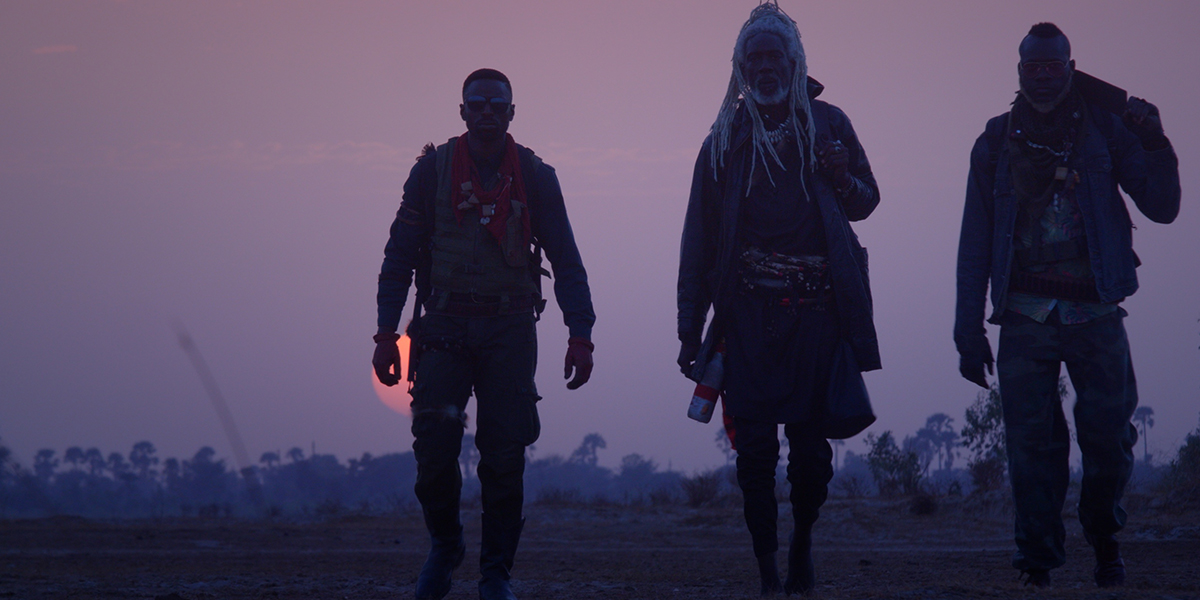
During a coup in Guinea-Bissau, three mercenaries extract their target, a Mexican cartel member, Felix (Renaud Farrah), and escape with him, his drugs and his gold. They are Baguin’s Hyenas: Chaka (Yann Gael), the red-gloved brains of the operation; Rafa (Roger Sallah), the more hot-headed and straightforward “brawn”; and the white-dreadlocked Minuit (Mentor Ba), who knows the spirit world and uses gris-gris on their missions. Or, you know, head, heart and spirit. En route to Dakar, they discover their plane is leaking fuel and land in the Sine-Saloum delta in Senegal. Burying Felix’s gold and narcotics, Chaka tells Rafa the plan: They’ll go to a nearby holiday camp and hide out until they can get fuel and resin to repair the plane so they continue on to Dakar. At Camp Baobob, they present themselves as vacationing gold mine workers and meet the genial Omar (Bruno Henry), who runs the camp, and his guests Sephora (Marielle Salmier) an artist; Youce (Cannabasse), Sephora’s ex-partner and current artistic collaborator; Awa (Evelyne Ily Juhen), a deaf woman who knows a lot about the Hyenas; and Cap. Souleymane Fall (Ndiaga Mbow) of the Dakar police. Omar doesn’t require payment from his guests, but he does ask that they do chores to contribute to the camp’s upkeep.

They have a lovely, delightfully cinematic dinner as everyone except Awa and the artists pretend they are there for some other reason than they are. They trade erudite observations. It has that charming feel of dinners in James Bond movies. Very little is as it seems and antagonists and protagonists spar, but politely and expansively. This is probably the only action movie I’ve seen where Léopold Senghor, poet, founder of the Négritude movement, and president of Senegal was referenced. Then again, Saloum is the only Senegalese action movie I have seen. After dinner, Minuit tells the men that there is an eye on them while Rafa believes something needs to be done because Souleymane is obviously preparing to capture them and Awa signed to them that she plans to reveal the Hyenas’ real identities if they won’t take her with them when they go.
The next day the guests all perform their assigned tasks, and then meet again that evening. And then, as they so often do, things go to hell over dinner. This is also where Saloum takes a turn. And I absolutely did not expect it.

Saloum is one of the best movies I saw at the festival this year. I can’t single out a performance, as much as I’d like to. I could write about any of the leads in depth. I could probably also write about Bruno Henry’s suave Omar or Ndiaga Mbow as his Souleymane goes from feeling cheerfully confident in his plan to capture Baguin’s Hyenas to his horrified realization that what he thought was going to happen is absolutely not what is happening. Saloum is a deft mix of genres--crime, action, horror, even maybe fantasy--and influences. It’s well-written and well-crafted. I appreciate how well Saloum integrates the particular history of the region, both in the story and in exposition. The breathtaking shots of the landscape use the whole screen and I love them for that. The pointed presence of the landscape in the film reminds me of Westerns and I wish more action movies used landscapes this way.
Now if you’ll excuse me, I’ll be watching Herbulot’s Sakho & Mangane on Netflix now that TIFF is over (for me at least).

By: Carol Borden
Bertrand Mandico After Blue (Dirty Paradise) / After Blue (Paradis Sale) (France, 2021) Humanity has moved off Earth, after wrecking it, and colonized another planet called, After Blue. Only “ovary-bearers” survived, as the planet has strange effects on the growth of hair and cis-men died when their hair grew inwards. The surviving high femme women made rules to prevent what happened on Earth from happening again. Well, at least some of it. They allowed only horses for travel and guns--bearing the brands of Gucci and Paul Smith--for hunting. They lived in small groups based on national identity, mostly. The film opens with a teenager named Roxy (Paula Luna) talking to another woman. She tells the story of finding a woman buried up to her neck in sand and releasing her in exchange for three wishes. Unfortunately for Roxy’s friends, the woman is the notorious criminal Kate Bush (Agata Buzek) and she kills all three of them.
As punishment the women of Roxy’s village order her mother, Zora (Elina Löwensohn), the village hairdresser, to hunt down Kate Bush and bring back proof of her death. Roxy comes along to help and because “she has nothing better to do.” And so they meet other women wearing broad brimmed 1970s lady hats for stetsons and glittery eye-shadow along the way and face death and sexual menace.

After Blue looks fantastic, with stylized space sound stages and dressing natural areas to they look like stylized space sound stages. I like the design of the dead. I like the sound design and the score. I like the make-up and the glowing femdroid eyes. Basically, I like almost everything about this film except the world-building and the story. They rub me wrong. I’m not comfortable with the implicit gender essentialism. And while I always enjoy rock people on alien worlds and dig these particular rock people’s geode heads, I’m not comfortable with the Indigenous people of After Blue, the “Indiams” or how they are treated or how they are represented even while knowing that Mandico probably means nothing by it. But I’m not in France. I’m in the United States. And “Indiams” especially rub me wrong after watching the TIFF Land Acknowledgment and a celebration of the work of Indigenous film maker and artist Alanis Obomsawin. And yes, I have watched Westerns with terrible people in them. And I have watched movies, like Neptune Frost, where the people are largely allegorical. But Zora aside, the women of After Blue are one note and that note is unpleasant. And the premise of a planet ruled by women who are sorta fashion-obsessed and whose civilization is catty and/or bitchy is hardly new. Please see nearly any post-World War II space lady movie from Cat-Women Of The Moon (1953) to Queen Of Outer Space (1958). (Ship Of Monsters / La Nave De Los Monstruous (1960) is lovely, though). Sometimes stream of consciousness just washes up the easiest and shallowest thoughtless representations. I can’t help wondering what Neptune Frost (Rwanda / USA, 2021) or Night Raiders (Canada, 2021) might have been like with these resources. And I really hope we decolonize better before we colonize other worlds. The human women of After Blue have not learned enough.
After Blue reminds me of 1970s French science fiction comics and looks like a very faithful adaptation of one that is happy to stay in the 1970s. But you might not have this reaction. You might find more effective and playful satire than I did. Maybe you’re just looking for style and cool ideas for aliens and alien landscapes to wash over you. Like I said, After Blue is well within the tradition of French science fiction--especially bande dessinée science fiction and if you like that, you might like After Blue (Dirty Paradise).


Arsalan Amiri, Zalava (Iran, 2021)
Zalava is a small farming village. Nearby is a military outpost. The year is 1978, before the revolution in Iran. All is not well in Zalava.
The film opens with a woman hauling a large pack. She walks down cramped village paths. She comes across something. She stops dead in her tracks. She stares ahead with palpable fear. Her nose starts to bleed. Villagers arrive at the military outpost screaming there is a demon in the village. “She’s possessed!” Villagers surround her. Her fear grows. The villagers fear grows. She backs away from the mob and falls down a cliff to her death.
After this tragic death a complaint is filed towards the Sergeant of the outpost, Sergeant Massoud. (Navid Pourfaraj) He is blamed for the death of the woman because he ordered all the guns in the village to be confiscated. A young soldier Younes reads the military order that Sergeant will be effectively relieved of duty by the next morning.
As the villagers line up to receive their confiscated guns one of the people is Khalaj Zalavaei the father of the woman who fell to her death. Upon receiving his rifle he points the gun at Sergeant Massoud and pulls the trigger. The rifle, empty of bullets clicks. The Sergeant’s last night in command will be a long one. A black cat ominously wanders the military post.
The village is once again gripped in throes of fear. Another demon is attacking the village. Massoud and Younes take a jeep and drive up the windy, mountain roads to the village. A couple of dead, mutilated sheep lay on the side of the road. As they arrive villagers are in full panic mode trying to escape and save their livestock.
Way back in November 2016 here in America, people, mostly white people, began to wear safety pins as an act of solidarity with visible minorities who were rightfully concerned for their well being as a populist was elected riding a wave of nationalism and xenophobia to the White House. The underlying thought was that a person who was being threatened, say on a city bus, would spot the white person wearing a safety pin and approach knowing that they were with a “safe” person. Needlessly to say, placing the burden on the person who was already in a dangerous situation. In Zalava we also see safety pins being worn by the villagers. The thought is the demons are repelled by metal. Further, to this end we also see many scythes hanging from doorways.

A traveling exorcist by the name of Amardan (Pouria Rahimi Sam) - a true highlight of the movie – shows up to assist the village in the removal of the current demon. Amardan removes his shoes and heads up the stone steps to the house with the possessed person armed only with an empty glass pickle jar. If he is successful he will return with the demon successfully trapped inside the jar. If he does not succeed he has given firm instructions that he is to be stabbed below the waist to effectively bleed the demon out which will still keep the village safe.
Another character that should be mentioned is Doctor Maliheh. (Hoda Zeinolabedin) She works in the village collecting samples of the villager’s blood and urine to send to a government lab to ensure the villagers overall health but because of the level of anxiety in the village the samples contain far too much adrenaline and are not effective as true samples. Sergeant Mossoud is also quite smitten with her. Another matter to note is although Dr. Maliheh is very much rooted in science and medicine she does still believe that there is a possibility that demons do exist.

The film is ultimately the test of two wills. Khalija the influential villager who lost his daughter to the demon who wholeheartedly believes in the supernatural influences surrounding Zalava and the will of Massoud who believes that all the demon fears are nothing more than superstition. Interestingly, Aramand may believe or may only be riding the wave of paranoia to cash in. As was mentioned earlier Dr. Maliheh is a person of science and still retains some belief that the demons could be real.
There are some wonderful standout scenes with Dr. Maliheh and Sergeant Massoud as well as Massoud and Amaradan debating if he is actually an exorcist or just a con artist. There is also some horror troupes of a black cat, creaky doors and shadows on the wall. One of the best scenes involves the black cat and the pickle jar.
I consider this one of the best films I have seen this the 2021 edition of the Toronto International Film Festival because as a demonic possession, exorcist film it is playing off the genre convention that the audience will dismiss the reality of the demon until the big third act fantastical reveal of the demon. We didn’t believe, but we knew it all along. Zalava wonderfully subverts expectations. The demons of fear and superstition were visible the entire time. We are watching a community give into fear and superstition.
For me one of the great scenes of the movie is when the mob riding on delirious fear begin arguing amongst themselves on how they should proceed, contradicting the many long held steps to demon exorcism and removal. One other thing I want to mention, is the entry point into the story is definitely through horror conventions however the film is also very much a love story.
The film takes place in a per-revolutionary Iran but parallels a lot of what I am seeing in the world right now with an invisible virus. People are eschewing science and medical fact to chase disbelief and unproven medical cures. Of which the end result is many times, very scary, tragic and deadly results.


Wen Shipei’s Are You Lonesome Tonight? / Re Dai Wang Shi (or, “Tropical Memories”) (China, 2021) is a remarkably assured first feature film that’s more like a traditional noir than many of the new wave of neo-noirs coming out of China right now--Diao Yinan’s The Wild Goose Lake (2019) or Bi Gan’s Long Day’s Journey Into Night (2018), for example.
Late one night, HVAC repairman Wang Xueming (Eddie Peng) encounters a recalcitrant ox in the road. Unable to pass, he takes another road and hits a pedestrian. And then, as happens in noir, Wang makes a decision that leads to a chain reaction of events. He disposes of the pedestrian’s body. It’s 1997 Guangzhou and there are no surveillance cameras. Wang doesn’t have a cellphone. No one will know and it’s easy to move on late at night when there’s no way to call an ambulance without waking people up and confessing.
Later, Wang recognizes Mr. Liang, the man he hit, from a missing persons poster and then encounters Mrs. Liang (the legendary actor and director Sylvia Chang) as she is distributing the posters. He decides he will confess to her. Meanwhile, Wang learns more and more about Mr. Liang. And it leads him somewhere dangerous even as he can’t help getting more involved in Mr. Liang’s secrets and Mrs. Liang’s life.

Eddie Peng embodies Wang’s guilt and fear well. He’s tense, silent and curled in on himself. There’s something in him he wants to say, but he just can’t bring himself to. It comes out in sweat, anxiety and cigarette smoke. There’s a great scene where Wang reveals his antihero ambivalence by berating a kid for smoking while stealing the kid’s cigarettes and lighter. Sylvia Chang is perfect as Mrs. Liang, a woman who is not a femme fatale but not exactly a model widow. She’s poised but she cannot cry. She doesn’t miss her husband, but she’s haunted by her past as a wife and mother. And the film occasionally shows us glimpses of her ghosts as she attempts to adjust to life on her own.
Are You Lonesome Tonight? has the lovely use of color I associate with Chinese neo-noir--influenced by the Taiwanese New Wave, Hong Kong films and, I assume, Jia Zhangke, who has his own neo-noir-ish film now, Ash Is Purest White (2018). Are You Lonesome Tonight? also plays with flashbacks, as when Mrs. Liang is haunted by memories of her husband and son or when the film alternates between Wang in 2005 and Wang in 1997. It has a very neat use of a flashlight for spotlighting actors engaged in specific actions during a confrontation on the street. And it has a dance studio sequence, which is another thing I’m starting to associate with mainland Chinese neo-noir.


Yuni is the third feature film by director Kamila Andini and marks her return to the Toronto International Film Festival. Kamila has the distinction of the first filmmaker to be presented twice in tiff’s Platform competition programme.
The film follows the title character Yuni (Arawinda Kirana), a typical teenager. She goes to school. She fixates on a cute teacher. She hangs out with friends and scrolls Instagram. The world she navigates is rooted in religious customs and tradition. People try and blackmail kids that they are engaging in sexual activities. At school Yuni wears a hijab. On her own she dresses in contemporary, vibrant clothing. At home –nearing the age of seventeen – several suitors are courting Yuni’s grandmother to arrange a marriage with the teenager. Left to her own devices Yuni goes on adventures of self-discovery.

Yuni has an obsession for the color purple, so much so, that she constantly steals purple items from other students, a water bottle, a food container. It does not matter what the item is as along as it is purple. This lands her Mrs. Lilis’ guidance councilors office. Mrs Lilis recognizes that Yuni is someone trying to forge their own path and instead of punishing the teenager, the councilor encourages Yuni to work towards going to college. In order for this to happen Yuni will have to be accepted in a special admissions program. She has to graduate third or higher in her class, have achievements in the humanities, sports or other activities and she must not be married.
As the pressure mounts for Yuni to get the highest grade possible she meets a boy Yoga (Kevin Ardillova). He is smitten with her and begins to write poetry for her assignments in Mr. Damar’s class, the teacher Yuni has a crush on.


Yuni is ultimately a beautiful poem of a young woman navigating the expectations of religion and a traditional society to forge her own path.


A film that stands as purely African and that also speaks unconditionally about universal truths, and is also respectful of the Sine Saloum area’s ancestral stories. The time has come for Katiopa (Africa in our indigenous language) to bring its heroes and myths into the modern mix. Growing up in Congo and witnessing the lack of African heroes as a child, it was my imagination of a bigger world that brought me to filmmaking. The creation of SALOUM is part of a bigger universe - a universe I based on reality and military and political history that I later tainted with a layer of adventure and horror.
SALOUM was created in collaboration with my creative partner, Pamela Diop. We went on a creative brainstorm weekend trip to the mystical and isolated region of Saloum, where Pamela has a deep and spiritual family history. It was here that the initial seeds of the story took shape. We wanted to capture the atmosphere of the region, the mysticism that lives in the air, and were also inspired to tell a story of strong characters on a tale of revenge. And then we decided to bring some heroes in... some colorful ones may I say. That’s how the Hyenas were born. That’s how Chaka was born. SALOUM is not a hero movie, but a movie about heroes. Heroes that we have not seen before. I love movies, I breathe movies, and SALOUM is my love letter to Africa and to cinema."

If cinema is a dream like state than Bertrand Mandico's latest film After Blue (Dirty Paradise) is pure uncut cinema.
Bertrand created the Incoherence Manifesto in 2012 with fellow filmmaker Katrin Olafsdotir. Bertrand states, "To be incoherent means to have faith in cinema, it means to have a romantic approach, unformatted, free, disturbed and dreamlike, cinegenic, an epic narration."
A voice says "You are no longer on your planet. You are in space." Hues of red and blue wash over us. "The Earth was sick so we had to look elsewhere." Rules were set once After Blue was discovered. Rules to avoid the same errors of Earth. No machines, no wavelengths, no chemistry. Living in micro-communities, based on nationality. Laws were set to cut the bad weeds. When evil appears, it's roots are cut. There are no men on After Blue. Once the planet was colonized, they all died early on. The hair of the men grew inside because of the atmosphere. The population of After Blue continues when women are inseminated with good Earth sperm.
We meet a woman by the name of Roxy (Paula Luna). The village girls have named her Toxic. On a beach Roxy and three other women run around. They find a head submerged in the sandy beach. They examine it and refer to it as an octo-whore. Soon the three women get tired of this find and strip naked and run out to the water to swim. The head begins to plead for Roxy to unearth it. "If you help me. I will grant you hidden desires. Three desires." The apple as a genie. Roxy frees the woman. Paradise might have been found but paradise still requires guns. As it is, the newly freed woman takes one of the guns stuck in the sand and shoots the three women who are still swimming. Setting off an epic narration of events.

The woman Roxy has freed reveals that her name is Kate Bush. She is recognizable because she is tall, has a hairy arm, a tattoo and an eye between her legs. Kate has already granted Roxy her first wish by eliminating her friends.
The village arrives at Roxy's mother's Zona (Elina Löwensohn) salon to demand Roxy and her go out and find and kill Kate Bush. To further reinforce this demand the Gucci rifle they are handed to accomplish this has a blue glowing inscription YOU WILL KILL KATE BUSH.
Slightly off topic but interesting, director Bertrand Mandico and Elina Löwensohn have began a project entitled "20+1 Projections" The project involves the pair making twenty-one short films in twenty-one years. The themes of aging and desire will run throughout these films.
When the current Pandemic began to take hold in March and April of 2020 I was personally drawn to post-apocalyptic cinema. Not the drab color palette Mad Max kind of cinema though, the Italians making films in 1970s New York City kind of cinema. The Enzo G. Castellari kind of cinema. The explosion of color and ridiculous leather vest as armor cinema. 1990 Bronx Warriors, The New Barbarians. There is something comforting that during the end times people have great hair and rock regalia that is more fashion esthetic than pure defense. As the pandemic continues, it also comforts me the people crafting films right now, in the Almost End of Blue, are also exploring colorful post-apocalyptic landscapes.

After Blue is the direct descendant of Alejandro Jodorowsky's El Topo. After Blue is the child of David Pelham's 1970s sci-fi, paperback covers. It is also to say Bertrand Mandico's film is midnight madness. The cinematography of Pascale Granel is exquisite as is the score by Pierre Desprats.
Clearly with a film of this ambition and weirdness, you are either going to be on board with this trip or you will not be.
On a final note, surprisingly or perhaps not, the world of After Blue looks eerily similar to wandering a cattle ranch in South Texas after eating things that sprout up from the Earth.

By Carol Borden
In Arsalan Amiri’s Zalava (Iran, 2021) there is certainly a demon among the people. They are scared and capable of anything. But is that demon their own fear or is there something else cursing them?
The film is set in 1978 in Zalava, Kurdistan, a village settled by Romani one hundred years ago. The village itself is beset by djinn that can only be controlled either by capturing the djinn in a jar or bottle or by wounding a possessed person below the waist. The people of Zalavi prefer to shoot someone in the leg as it has a higher chance of survival but they also will stab or cut a person below the waist so that they “blood spurts.” This prevents the demon from possessing others. As the film opens, a young woman has been declared possessed and the villagers have summoned Sgt. Massoud Amhadi (Navid Pourfaraj) to do something about it. Massoud confiscates the villager’s rifles to prevent them from hurting the girl. He tells them, “She’s better possessed than having you mutilate her.” But after Massoud, his sidekick / underling Younes (Baset Rezaei) and the rest of the local gendarmerie return to their station outside Zalava, the girl’s father draws his knife to do what he believes must be done. Unfortunately, as she backs away from him, she falls to her death.

The local people complain to the government, blaming Massoud for her death and his illegal confiscation of their rifles. Massoud receives orders to step down and return the rifles. The day before he is to retire, he dons a very 1978 suit, goes to sign papers and turn in his badge. But the villagers return to the station demanding that he do something about the demons attacking Zalava. Instead of telling the new commander it’s his problem now, Massoud dons his uniform and returns to Zalava to discover metal implements hung in front of doors and strung across alleys to scare the demons away. Everyone is terrified. Some appear to be convulsing. And the center of the activity is a house people are certain now contains a demon. They have called a ritual specialist, Amardan (Pouria Rahimi Sam) to exorcise the demon. Amardan tells the assembled villagers to bring their rifles and all the musicians. The musicians come, but no one will bring a rifle because they believe Massoud will seize them again. Amardan tells Massoud to shoot him in the leg if he comes out empty handed. Then he asks someone to stab him in the leg if Massoud is too afraid to shoot. Amardan comes out of the house carrying a clear jar that he claims contains a djinn. The musicians play. Everyone dances. Massoud is extremely skeptical. And now the real suspense begins.
Like a lot of folk horror, Zalava relies on the fear of what people are capable of based on their beliefs and what might be happening that’s rooted in things from long ago that urban and urbanized people might no longer understand. But Zalava also reminds me of Val Lewton’s psychological horror movies at RKO in the 1940s. Though there is a lot of successful suspense built around it in the film, it doesn’t really matter if there is a demon in that jar. The demon’s presence or absence is less important than the destructive power that people themselves are capable of. It’s hard to see how one djinn is really worse than a village of people willing to shoot, stab and even kill each other in their fear that something secret is wrong with someone among them. And the accused we see before they are shot, stabbed or driven off the edge of a building don’t seem much different than anyone else. Though while embodied djinn seem initially innocuous, we do hear that Amardan can send disembodied djinn to do things like pee in dams. While watching Zalava, I couldn’t help thinking about Emir Ezwan’s Roh / Soul (Malaysia, 2019), another film with another demon setting people against each other. But as that demons says, “All we do is whisper.” In Zalava, our fear and panic is far more destructive than any demon could be by itself.

I assume there are social and political implications that aren’t immediately apparent to me in setting the film before the Iranian Islamic Revolution in 1979, but I do appreciate setting it in that time for other reasons. Massoud’s suit and the film’s color palette certainly reflects that era in film. There are some beautiful shots of Massoud’s tan jeep driving through arid, rocky mountains. I didn’t mention Dr. Maliheh (Hoda Zeinolabedin) in my synopsis, but she is integral to the film and she has fantastic chemistry with Navid Pourfaraj’s Massoud. Pourfaraj is another actor who conveys so much with his eyes alone.
I also appreciate director Arsalan Amiri’s point in his introduction that this kind of panic can happen anywhere anytime. It’s not specific to this place. At the same time, I am not entirely comfortable in setting it among an ethnic minority, Kurdish Romani, even as I know that having some kind of other who is simultaneously outside society and involved in secret and perhaps dangerous supernatural activity is a common story the world over. I don’t know enough history about the area or of Iranian film to say more about whether the people of Zalava are even read as Kurdish or Romani. All that aside, Zalava is an excellent film. And we are wise to remember that, yes, these panics can happen anywhere and we should watch out for them not just in others, but in ourselves because they always feel righteous.
And if you are concerned about the kitten or the rabbit, they don’t die.

By Carol Borden
Maria Schrader I’m Your Man / Ich bin dein Mensch (Germany, 2021)
Sure, there are a lot of movies about people falling in love with androids, robots and AI, but a lot of them are about the risks and even dangers of men falling in love with robots. In Ex Machina (2014), Her (2013), and Godzilla vs Monster Zero (1965 / 1970), for example, men have learned what it is to feel a love beyond computation. And there is even The Companion (1993), in which a woman falls in love and experiences the perils of a smitten Bruce Greenwood android with full autonomy. But that doesn’t mean that there’s not room in my heart for one more.
Unlike Her, Ex Machina, The Companion and Godzilla vs Monster Zero, Maria Schrader’s I’m Your Man / Ich bin dein Mensch (Germany, 2021) is mostly a romantic comedy. It just has some additional existential drama. Schrader is also an actor. You might know her from Aimeé & Jaguar (1999) or Nobody Loves Me / Keiner leibt mich (1994), but she has moved into directing and I am happy she has.
Dr. Alma Falsar (Marren Eggert) is working on breakthrough research she is about to publish on previously undiscovered poetry in cuneiform tablets at Berlin’s Pergamon Museum. The museum’s administration has offered her additional funding if she’ll participate in an experiment. She’s to spend three weeks with an android designed to be her perfect partner* and then write an evaluation that will help determine whether or not robots should be allowed to marry and have other rights in society. Of course, this funding is a “thank you gift” and not a bribe.
Alma meets Tom (Dan Stevens) at a special club designed to show off the romantic possibilities of androids--and even holograms. Tom attempts to woo her with compliments and the rhumba, but it’s not really Alma’s thing and she seems more interested in him as a robot than a potential partner. She does, however, take Tom home and set him up with his own room. And so the experiment begins.
In another film, Tom might rampage or we might discover he is more “human” than human. Another film might let Tom be hit by a streetcar for maximum pathos or to resolve the central conflicts it has set up about what it means to be happy and what it means to have a perfectly compatible partner who only wants to make you happy and give you everything you want. Another film might echo the warnings of earlier science fiction that the robots will trick us by being perfect servants and then take over. (Shades of Benito Cereno). I’m Your Man / Ich bin dein Mensch does not. But it does provide the possibility of Alma navigating her principles and concerns while also, perhaps, allowing herself to love and be loved. And I appreciate that it navigates issues of consent well--not only Alma’s but Tom’s ability to consent.
The above might make it sound like the film is not funny, but I have to say that Dan Steven’s Tom was hilarious to me. His reactions, his romantic poses, his delivery and his too much intense eye contact and initial overuse of Alma’s name were all on point. Marren Eggert’s responses to Tom are similarly hilarious. Her bewilderment, her incredulity, her absolute bafflement and exasperation at times were delightful And I enjoyed how Tom and Alma would watch each other in different ways. The film has a lovely and quiet use of the gaze. And Marren Eggert is fantastic as Alma moves towards a vulnerability that she does not want to feel and that makes her feel more alone. But Alma’s integrity and her commitment to her work and living as she thinks she should are not compromised. They are just complicated by not just her growing feelings for Tom, but by her curiosity about him. I’m Your Man is another favorite at this year’s festival and I’d gladly watch it again.
(Incidentally the Bleecker Street trailer translates Alma saying “This is the penis of my dreams” as “This is the man of my dreams.” You know better, Bleecker Street).
*A Mechanized Organism Designed Only For Marriage. I want to be more sorry about this joke than I am.

By Carol Borden
Kate Dolan’s You Are Not My Mother (Ireland, 2021) has it all: Irish folk horror! Fraught family dinners! Teen girl drama! Possible Lesbianism! Ostracism! Halloween/Samhain! These are things that I normally have a lot to say about, but I have to restrain myself and wait. So let’s get to some thoughts I can share now without revealing too much.
The film opens with a baby in a baby stroller on a street a night. An old woman with a limp takes the baby away and seems to put it in a ring of fire. We watch the woman’s face as it cries. And then teenager Char Delaney (Hazel Doupe) wakes up. She lives with her mother, Angela (Carolyn Bracken), and grandmother (Ingrid Craige). Angela suffers from depression. This morning, Char asks her mother to drive her to school and Angela manages to get herself out of bed and into the car, but struggles mightily when Angela asks her to go to the shops and get some food for the house after dropping her off. After a near accident with a folk horror element leaves them sitting in the car in the village green, Angela tells Char, “I can’t do this anymore.” Frustrated with her mom’s inability to, well, mom, Char leaves the car and walks the short distance to school alone. And then Angela disappears.
Char and her Uncle Aaron (Paul Reid) are worried, though Aaron tries to reassure Char. But Char’s grandmother is certain that Angela will return. And Angela does late that night, but something’s not right. It’s just hard to say what. Is it her new meds? Is it manic-depression? Is it something else? She’s manic and dancing and not careful with her own body or others. Char’s grandmother is also acting suspicious. She watches Angela and interferes with Angela’s attempts to repair her relationship with Char. And Char is alone. Her family is ostracized by the community. Her schoolmates at her local Catholic school (*cough* “Brigid” *cough*) bully her. It seems they always have abused her. This time it’s ostensibly because they worry that she’ll rat them out as they plan a bonfire for Halloween / Samhain. Except for Suzanne (Jordanne Jones) who bullies Char, but also seems kind of into her. And what’s up with this impending school field trip to a site with pre-Christian stone carvings?
The film has a suitable moody, Gothic look at night. In the daytime, the cinematography and blocking emphasizes Char’s isolation, especially in the lighting of her school. And the soundtrack by Die Hexen (aka, “The Witches” in German) helps maintain the mood without being obtrusive. All the performances are excellent, but I want to single out Hazel Doupe and Carolyn Bracken. As Char, Doupe does a tremendous amount of work with just her eyes, which always impresses me, as she tries in the beginning to maintain a front that everything is fine and later maintain an appearance of calm to avoid setting off cruel classmates, her family and ultimately her mother. Bracken does a remarkable job as Angela swings from bone-crushing guilt, weariness and love to manic joy to confusion at Char’s fear and, in the end, to a monstrous love.
You Are Not My Mother is one of my favorite movies of the festival this year and I am excited to write more about it in more depth after it has been more widely released.
