
On a quiet Sunday a week after the 2021 Toronto International Film Festival ended I was able to sit down over zoom with director and writer of Dug Dug, Ritwik Pareek. We had a great in depth interview about the making of the movie.
On a quiet Sunday a week after the 2021 Toronto International Film Festival ended I was able to sit down over zoom with director and writer of Dug Dug, Ritwik Pareek. We had a great in depth interview about the making of the movie.

By Carol Borden
Evan Jackson Leong Snakehead (USA, 2021)
Snakehead chronicles the life of Sister Tse (Shuya Chang) after she has paid a snakehead--a human smuggler similar to a coyote--to bring her to New York so she can find her daughter. Sister Tse is very practical about this arrangement, so practical she works her way up the ranks of the local family holding her debt and attracts the attention of gang matriach and community benefactor, Dai Mah (Jade Wu). Sister Tzu also attracts the attention of Dai Mah’s son, Rambo (Sung Kang), who is jealous of her relationship with his mother.
Snakehead is based on the true story of infamous leader of a human trafficking ring in New York, Cheng Chui Ping, aka, Sister Ping. And it is definitely a story worth telling. But no matter how much I want to see this story and I want to like it, Snakehead is uneven. It does not feel finished. It feels like maybe it needed another draft. On one hand, I appreciate grounding the film in the community and some of the strongest elements are related to that almost documentary feel. On the other hand there is also frequently awkwardness in line delivery. Sister Tse’s narration felt rote and didn’t create a smooth narrative flow between the segments we see from her life. It feels more like dramatized segments in a documentary about someone’s life. And this makes me think about whether Snakehead might work better as a documentary than a drama / action movie. But the thing is, I want the action movie that Snakehead is trying to be. The documentary would be interesting, but the action movie that shares this world and the lives of the women inhabiting it is an amazing vision.

And there are some real strengths in the film, Ray Huang’s cinematography for instance. Shuya Chang is charismatic as Sister Tse. Sung Kang is suitably frightening as the out of control Rambo. But Jade Wu steals the film as Dah Mah, bringing an outstanding depth to her character and a flawless delivery.
Snakehead tries something new in terms of story, and I cannot appreciate that more. I hope everyone working on it keeps working on getting stories like this made. Because even if Snakehead doesn’t entirely succeed, it’s a start.


At the genesis of SALOUM, there is the meeting of my partner in crime Jean-Luc Herbulot. We both had a visceral need to create works in Africa, filled with heroes and monsters. It was what we craved as kids to see coming from African film, so we created it ourselves. During a trip to the Saloum region of Senegal in 2018, we wrote the short story “The Twilight of the Hyenas” an African western... a horror film... a fantastic epic... an ode to the imaginary world in which we would like to stay and a furious artistic deliverance rather than a desire to fill an empty box.

The movie was filmed in nature, mostly in the mystical and wild region of Saloum, Senegal where my journalist father had filmed wrestling matches more than forty years ago and where my mother still lives; on an island without cars, far away from all levels of city life.

SALOUM is the first feature film from LACME STUDIOS, co-constructed with the actors and technicians, day-after-day for five straight weeks - the epic adventure of a group living outside the comfort of their respective homes, much like the hero-mercenaries of the film itself. The absence of a network, the random supply of water, the regular silting up of vehicles... blood was shed along with tears. SALOUM is the result of the talents we gathered who were kind enough to follow us on this adventure.
The production of SALOUM was a natural shifting of gears, the result of adrenaline rushes, soul encounters, inevitable pains, loves, the divine and fears of emptiness ... a birth of a bloody new-born already adored by its parents.

"When you want to succeed as bad as you want to breathe ..." Eric Thomas recounts in his motivational speech, explaining how an old man kept his student's head under water, thus demonstrating the true meaning of the word "motivation.” This best explains why I believed in this film, why I expected it and why I didn’t hesitate to take the risk.
It’s important for me to release African artistic madness, so universal and yet so rare on international screens.


What is your background as a filmmaker?
No film-school. No camera. Just an eight-year-old filled with feverish dreams. I am and always have been what I refer to as a hostage of creativity. As an adult, I finally found the outlet to release those dreams into visual stories.

What was your initial inspiration for making SALOUM?
A lucid dream and an experience of drowning. When I was a kid, 5 or 6 years old, in Congo, I was alone on the seashore, and I suddenly got sucked into the water. I fought my way back but remember losing it and just letting go... But then, I finally came out of it, like somebody pushed me back to shore. I remember being helped by an adult that was guarding me. This guardian said I had disappeared for more than five minutes. And she was not joking, she was crying and scared to death. That experience made me question about the unknown and perceptions. Later on, some years ago, I was in Dakar. I was pretty sick, feverish, but I won my battle against insomnia that night. I slept and had this weird dream of floating and being a camera in the middle of a gunfight, more precisely an execution. I witnessed a military kid going forward, gun pointed to his destiny/enemy? Who was that kid morphing into an adult? The rest is in the movie.

The performances in the film are exceptional– what was your casting and rehearsal process?
I don’t go through a traditional casting process I spend time choosing people I want to work with. We all lived together in the camp that you see in the film, so the tenderness and the tensions were based on reality. The performances in SALOUM are what happens when you isolate thirty people with a thirst for creativity in a contained desert camp, in a spiritually overloaded environment.
What are your cinematic and creative influences, and how did they influence the making of SALOUM?
Red Dead Redemption 2, the ancestral spirits of Saloum and “The Strummer’s law” – the idea that a constant flow of creative inspiration into one's life is as important as breathing.


By Carol Borden
Camille Griffin’s Silent Night (UK, 2021) was not the cozy British Christmas movie starring Keira Knightley I was expecting. Sure, it starts with a range of well-off couples singing along to a Michael Bublé Christmas song as they drive to a beautiful house in the English countryside. Tony (Rufus Jones), Sandra (Annabelle Wallis) and their daughter Kitty (Davida McKenzie), James (Ṣọpé Dìrísù) and Sophie (Lily-Rose Depp), and Bella (Lucy Punch) and Alex (Kirby Howell-Baptiste) all seem to be in good spirits as they reveal comedicaly charming little cracks in their relationships. But they are gamely trying their best for a Happy Christmas among old friends. And, sure, Nell (Keira Knightley) is madly trying to finish dinner in time for everyone’s arrival with the help of her son Art (Roman Griffin Davis) while her husband Simon (Matthew Goode) corrals their other two sons, Thomas (Gilby Griffin Davis) and Hardy (Hardy Griffin Davis), into the bath and lays down the screen time and swearing rules for the night. Of course, there are problems with dinner preparation. There are only enough potatoes for each person to have one. Nell didn’t get the sticky toffy pudding promised to Kitty this year. And Art cuts himself and bleeds on some of the carrots. And this is where little things start to accumulate. Nell is hosting a lot of people and can be hard to figure out how much food is enough for 12 people, including four tween or teen children. But why doesn’t she throw out the bled upon carrots? Why do her friends still eat the raw carrots after seeing some blood on them? And when Sandra and Nell send Simon and Tony to the store for sticky toffy pudding, why do they suggest throwing a rock through the store window?
Silent Night is not a cozy Christmas reunion in the country movie. A kind of movie that is beloved whether filmed in British Columbia for the Hallmark Channel or stars beautiful posh English people on the big screen. Silent Night is another entry into the genre of white people dinner parties--terrifying whether it’s just unpleasant interactions with awful people in many, many period pieces or the hosts are pleasantly planning terrible things, as in Adam Wingard’s You’re Next (2011), Karyn Kusama’s The Invitation (2015) or Jordan Peele’s Get Out (2017). This Christmas dinner is a danse macabre or, a la Boccaccio, a plague dinner. Old school friends with two “new” tolerated partners, Alex and Sophie, gather to celebrate one last time before the end. But the plague is not a virus or bacteria. It’s a toxic storm caused by climate change and everyone who has been caught in the gases spreading over the earth has died bleeding out their eyes. The house is beautiful, the wallpaper is worthy of Louis Wain, the friends are eating and dancing together, but the carrots are bloody and the poisonous storm is coming.
The friends gather together in the name of “love and forgiveness.” They also gather to explain to their children what’s happening. Or rather, they explain once they have to. As Sophie, interloping American partner of James the oncologist says, “Posh people like to keep secrets.” And because Silent Night is a comedy, a very dark one, Nell and Simon gather their sons to tell them, “We just want you to understand as your parents, we are not to blame. This is not our choice and this is not our fault.” But none of this goes over well with the children. I think Roman Griffin Davis’ Art will rightfully get a lot of attention, as will Davida McKenzie’s powerhouse performance as the imperious Kitty. But I just want to share my love of Hardy and Gilby Griffin Davis’ delivery as the very chill twins.
Silent Night is a comedy that involves a lot about class and maintaining appearances, both personally and socially. But I think it also deliberately subverts its characters belief that everything and everyone is kind of awful underneath--especially through the character of Alex, a black Lesbian observing many of the shenanigans around her and once using a Scrabble board to comment on secrets being revealed, before remarking to Bella in private, “They’re all so mean.” Alex has seen people not like Bella’s friends even in the world of Silent Night. And many of those people are out there excluded from the British government’s plan for dealing with the toxic gases.
Silent Night was absolutely not what I was expecting. I’m glad Robert Mitchell recommended it to me without telling me why. I do hope they include director Camille Griffin’s video introduction to the film in any video release. I am not sure many people will have that same experience of going in blind, because Silent Night is not a film to suggest to people who want to see a nice, cozy movie to enjoy over the holidays. It would be traumatizing. And a lot of people who would enjoy it might be put off by a Keira Knightley cozy Christmas movie. But I am sure whoever distributes it will find a way because Silent Night is a not movie that is ruined by knowing what it’s about, without knowing too many specifics of what happens. That said, there are some jokes I’d love to repeat here--especially one about The Road (2006). But I won’t. You should probably see it for yourself.

This is how topsy-turvy the world is. My final movie at the
2021 Toronto International Film Festival is a Keira Knightley Christmas movie.
One of the great things about attending a film festival, is to walk into a movie
theater or, as is my case this year - stream a movie - you have no idea about. This movie with a premise of a midnight madness movie was a complete surprise. I loved it.
It is Christmas afternoon. Nell (Keira Knightley) and her son Art (Roman Griffin Davis) are in the kitchen preparing dinner. Michael Bublé plays. It is a beautiful afternoon in the English countryside. Perfect. Peaceful. Art is cutting carrots and cuts his finger. Blood spurts all over the carrots.
Family and friends begin to arrive. Some eat the bloody carrot bits. They either do not notice or do not mind. The kids run around the house and get in each other’s hair. This leads to a lot, a hell of a lot of children profanity. It is stupid, fucking funny.
"Tonight is all about love and forgiveness." Nell proclaims to everyone who has assembled for this Christmas celebration. Tonight will indeed be about a lot of things.
Another common thread that I have seen with the movies I have watched this year the Toronto International Film Festival is great dinner sequences. You Are Not My Mother, Saloum, Unclenching The Fists. Silent Night also contains a dinner scene, and it is amazing and the centerpiece of the entire movie.
Dinner is served. There are hints that something far greater is happening outside this family Christmas dinner. The potatoes are rationed. One potato per person. A prayer is begun. It is awkward and funny. Nell contributes to the prayer, “To love we have shared.” The word, “have” hangs in the air. One of the guests Bella (Lucy Punch) looks out the window. Her look of nervousness is at odds of the beautiful blue sky out the window. The conversation turns to the Queen’s speech. "Well she is clearly in some bunker setup", says Tony (Rufus Jones). Nell quips, "If you want to live in a hole and eat dog food..." "It's fine because she's old" Kitty (Davida McKenzie) quips.
The dinner conversation gets even better when Art brings up Greta Thunberg. Roman Griffin Davis and Davida McKenzie play exceptionally well off of one another. Sofie (Lily-Rose Depp) begins to expound upon the difficult night she had last night. The adults are trying to change the conversation but the kids want to hear more. "We had dinner, sang Celine Dion, dance to Brittney, laugh, cried..." Sophie gets out before the subject is changed.
Someone mentions, that they should be honest with the kids. Art insists that his parents have told him the truth. Kitty interjects, "The Russians want us all dead and are sending poisonous gas to kill us all. They are obsessed with world domination." Art, "Do not be ridiculous Kitty it isn't the Russians. The planet has absorbed every ones filthy rubbish, it had enough and it cannot take it anymore so it's spitting it back out as a fuck you to the world."
It is mentioned that the government of the United Kingdom cares for it's people and has provided aid and assistance to the residents of the country that will abate pain and suffering. There is a website Exit.Gov.Co.Uk that provides information on how to Die With Dignity. The government has provided other tools to alleviate the fate that awaits million and millions of people. Art points out that all of this government assistance is not available for everyone in the country and he is adamant that he will not follow along with the government instructions.
Christmas must go on. Games are played. Spirits are imbibed. Presents are wrapped. In another revelation of rationing and a clue to the big story, the presents are wrapped in newsprint. Art holds a present with the headline: New York Governor Declares State Of Emergency. Burrough Of Queens death toll passes two million. As we garner subtle hints of life in this catastrophic world, watching people proceed with a high degree of normalcy we wonder what the fuck is actually happening out in the world. People surly are not playing charades, sipping on champagne.
As the tsunami of toxic gas races towards the English countryside and the moment of mortality approaches the tension and anxiety infuse the movie with such great moments. The pathos of humanity is on full display. I, the audience, sitting relatively safe in the "real world", it is all a delight. Except for the back of your brain reminding you of the ongoing pandemic and the climate change that is getting worse everyday. The entertainment of it all runs parallel to the very real - not too far from now - "real world" scenarios that could very well come to fruition.
Writer and Director Camille Griffin said in her introduction, "I believe as the world becomes more fragile, society becomes more divided between those that do and those that don't give a damn about one another. With Silent Night I wanted to investigate the world of privilege to see what might happen when catastrophe knocks at their door. No amount of money, education, good manners can save anyone from the inevitable. She wrote the script pre-Covid without any knowledge of the pandemic. Covid didn't enter the world until after shooting on the movie began. What has become clear to everyone is it is incredibly hard to protect societies in the world. We need to step up and take care of one another. How far are we prepared to go to protect the ones we love and how far are we prepared to protect the rest of the world."
I love a movie that changes tones like a whiplash. I loved
the many tones contained in this movie. There are so many great performances in this movie, to single one out feels as though to take away from the work this ensemble cast created. That being said, Roman Griffin Davis is absolutely amazing in this film. Camille Griffin's feature film debut will go up with White Christmas and It's A Wonderful Life for ever how many Christmas nights I and the rest of humanity on the planet have left.

By: Carol Borden
Jean Luc Herbulot Saloum (Senegal, 2021)
Saloum was one of my favorite movies at this year’s festival and if you know you like action movies with mercenaries in them, I’d suggest just seeing it without reading or watching anything more about it. I’m not including any serious plot details in this piece, but I also think that Saloum can’t really be spoiled.
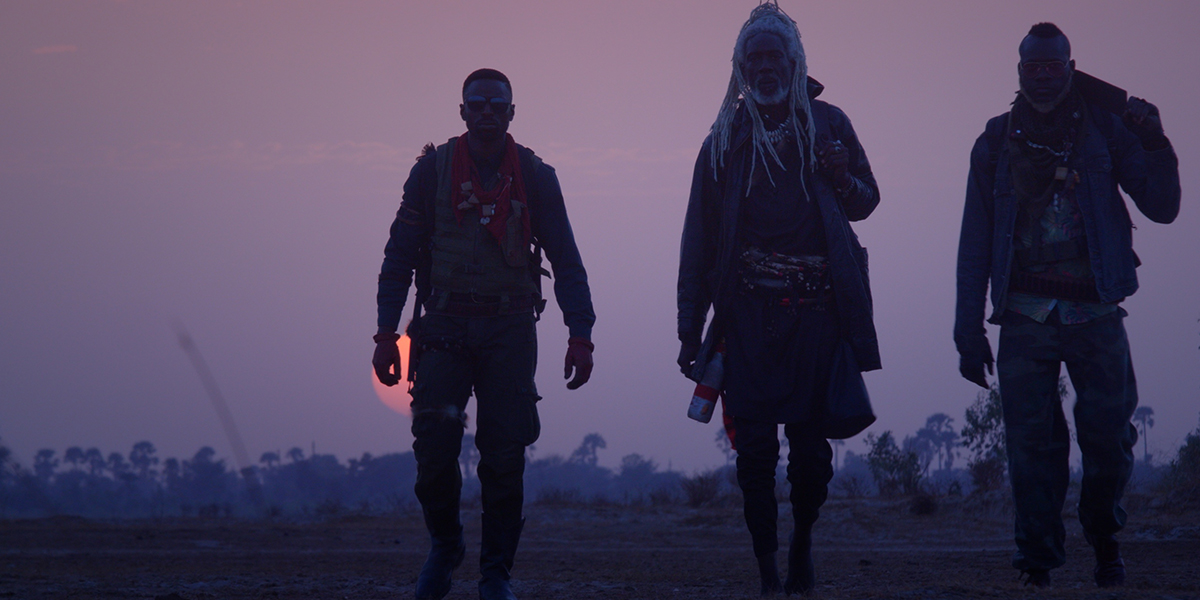
During a coup in Guinea-Bissau, three mercenaries extract their target, a Mexican cartel member, Felix (Renaud Farrah), and escape with him, his drugs and his gold. They are Baguin’s Hyenas: Chaka (Yann Gael), the red-gloved brains of the operation; Rafa (Roger Sallah), the more hot-headed and straightforward “brawn”; and the white-dreadlocked Minuit (Mentor Ba), who knows the spirit world and uses gris-gris on their missions. Or, you know, head, heart and spirit. En route to Dakar, they discover their plane is leaking fuel and land in the Sine-Saloum delta in Senegal. Burying Felix’s gold and narcotics, Chaka tells Rafa the plan: They’ll go to a nearby holiday camp and hide out until they can get fuel and resin to repair the plane so they continue on to Dakar. At Camp Baobob, they present themselves as vacationing gold mine workers and meet the genial Omar (Bruno Henry), who runs the camp, and his guests Sephora (Marielle Salmier) an artist; Youce (Cannabasse), Sephora’s ex-partner and current artistic collaborator; Awa (Evelyne Ily Juhen), a deaf woman who knows a lot about the Hyenas; and Cap. Souleymane Fall (Ndiaga Mbow) of the Dakar police. Omar doesn’t require payment from his guests, but he does ask that they do chores to contribute to the camp’s upkeep.

They have a lovely, delightfully cinematic dinner as everyone except Awa and the artists pretend they are there for some other reason than they are. They trade erudite observations. It has that charming feel of dinners in James Bond movies. Very little is as it seems and antagonists and protagonists spar, but politely and expansively. This is probably the only action movie I’ve seen where Léopold Senghor, poet, founder of the Négritude movement, and president of Senegal was referenced. Then again, Saloum is the only Senegalese action movie I have seen. After dinner, Minuit tells the men that there is an eye on them while Rafa believes something needs to be done because Souleymane is obviously preparing to capture them and Awa signed to them that she plans to reveal the Hyenas’ real identities if they won’t take her with them when they go.
The next day the guests all perform their assigned tasks, and then meet again that evening. And then, as they so often do, things go to hell over dinner. This is also where Saloum takes a turn. And I absolutely did not expect it.

Saloum is one of the best movies I saw at the festival this year. I can’t single out a performance, as much as I’d like to. I could write about any of the leads in depth. I could probably also write about Bruno Henry’s suave Omar or Ndiaga Mbow as his Souleymane goes from feeling cheerfully confident in his plan to capture Baguin’s Hyenas to his horrified realization that what he thought was going to happen is absolutely not what is happening. Saloum is a deft mix of genres--crime, action, horror, even maybe fantasy--and influences. It’s well-written and well-crafted. I appreciate how well Saloum integrates the particular history of the region, both in the story and in exposition. The breathtaking shots of the landscape use the whole screen and I love them for that. The pointed presence of the landscape in the film reminds me of Westerns and I wish more action movies used landscapes this way.
Now if you’ll excuse me, I’ll be watching Herbulot’s Sakho & Mangane on Netflix now that TIFF is over (for me at least).
