Showing posts with label Pamelá Diop. Show all posts

Monday, September 20, 2021

TIFF 2021 SALOUM: Paméla Diop Producer Statement


At the genesis of SALOUM, there is the meeting of my partner in crime Jean-Luc Herbulot. We both had a visceral need to create works in Africa, filled with heroes and monsters. It was what we craved as kids to see coming from African film, so we created it ourselves. During a trip to the Saloum region of Senegal in 2018, we wrote the short story “The Twilight of the Hyenas” an African western... a horror film... a fantastic epic... an ode to the imaginary world in which we would like to stay and a furious artistic deliverance rather than a desire to fill an empty box.


The movie was filmed in nature, mostly in the mystical and wild region of Saloum, Senegal where my journalist father had filmed wrestling matches more than forty years ago and where my mother still lives; on an island without cars, far away from all levels of city life.


SALOUM is the first feature film from LACME STUDIOS, co-constructed with the actors and technicians, day-after-day for five straight weeks - the epic adventure of a group living outside the comfort of their respective homes, much like the hero-mercenaries of the film itself. The absence of a network, the random supply of water, the regular silting up of vehicles... blood was shed along with tears. SALOUM is the result of the talents we gathered who were kind enough to follow us on this adventure.
The production of SALOUM was a natural shifting of gears, the result of adrenaline rushes, soul encounters, inevitable pains, loves, the divine and fears of emptiness ... a birth of a bloody new-born already adored by its parents.


"When you want to succeed as bad as you want to breathe ..." Eric Thomas recounts in his motivational speech, explaining how an old man kept his student's head under water, thus demonstrating the true meaning of the word "motivation.” This best explains why I believed in this film, why I expected it and why I didn’t hesitate to take the risk.


It’s important for me to release African artistic madness, so universal and yet so rare on international screens.


TIFF 2021 SALOUM: A Few Questions & Answers with Director Jean Luc Herbulot


What is your background as a filmmaker?


No film-school. No camera. Just an eight-year-old filled with feverish dreams. I am and always have been what I refer to as a hostage of creativity. As an adult, I finally found the outlet to release those dreams into visual stories. 


What was your initial inspiration for making SALOUM?

A lucid dream and an experience of drowning. When I was a kid, 5 or 6 years old, in Congo, I was alone on the seashore, and I suddenly got sucked into the water. I fought my way back but remember losing it and just letting go... But then, I finally came out of it, like somebody pushed me back to shore. I remember being helped by an adult that was guarding me. This guardian said I had disappeared for more than five minutes. And she was not joking, she was crying and scared to death. That experience made me question about the unknown and perceptions. Later on, some years ago, I was in Dakar. I was pretty sick, feverish, but I won my battle against insomnia that night. I slept and had this weird dream of floating and being a camera in the middle of a gunfight, more precisely an execution. I witnessed a military kid going forward, gun pointed to his destiny/enemy? Who was that kid morphing into an adult? The rest is in the movie.


The performances in the film are exceptional– what was your casting and rehearsal process? 

I don’t go through a traditional casting process I spend time choosing people I want to work with. We all lived together in the camp that you see in the film, so the tenderness and the tensions were based on reality. The performances in SALOUM are what happens when you isolate thirty people with a thirst for creativity in a contained desert camp, in a spiritually overloaded environment.


What are your cinematic and creative influences, and how did they influence the making of SALOUM?
 

Red Dead Redemption 2, the ancestral spirits of Saloum and “The Strummer’s law” – the idea that a constant flow of creative inspiration into one's life is as important as breathing.


Saturday, September 18, 2021

TIFF 2021 SALOUM: Reflections By Carol Borden


 By: Carol Borden 

 Jean Luc Herbulot Saloum (Senegal, 2021)

Saloum was one of my favorite movies at this year’s festival and if you know you like action movies with mercenaries in them, I’d suggest just seeing it without reading or watching anything more about it. I’m not including any serious plot details in this piece, but I also think that Saloum can’t really be spoiled.

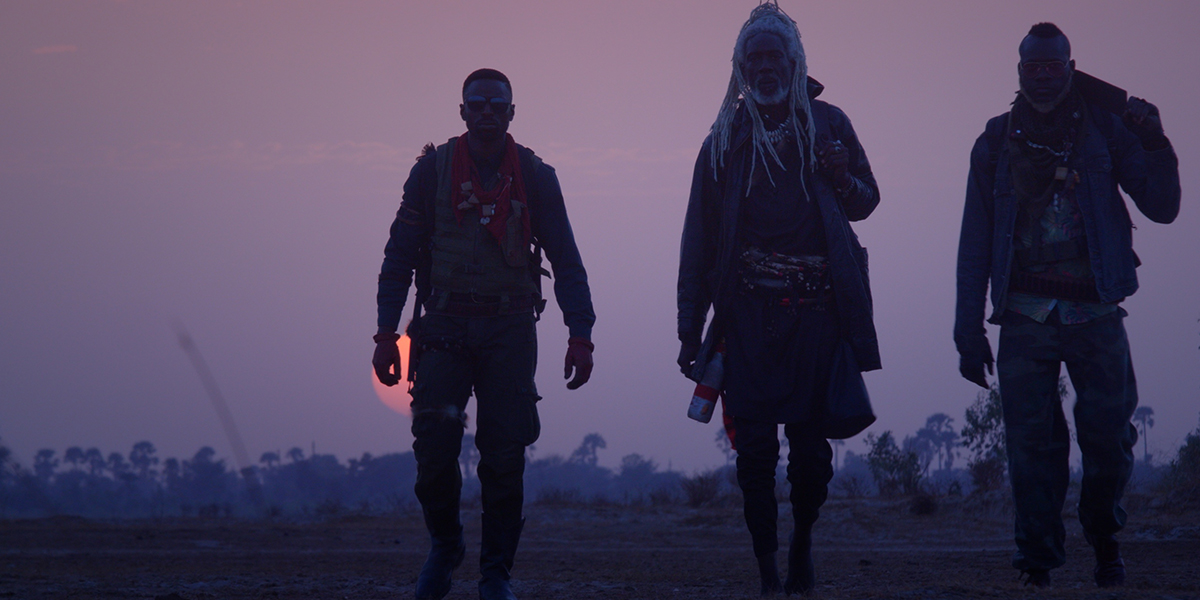
During a coup in Guinea-Bissau, three mercenaries extract their target, a Mexican cartel member, Felix (Renaud Farrah), and escape with him, his drugs and his gold. They are Baguin’s Hyenas: Chaka (Yann Gael), the red-gloved brains of the operation; Rafa (Roger Sallah), the more hot-headed and straightforward “brawn”; and the white-dreadlocked Minuit (Mentor Ba), who knows the spirit world and uses gris-gris on their missions. Or, you know, head, heart and spirit. En route to Dakar, they discover their plane is leaking fuel and land in the Sine-Saloum delta in Senegal. Burying Felix’s gold and narcotics, Chaka tells Rafa the plan: They’ll go to a nearby holiday camp and hide out until they can get fuel and resin to repair the plane so they continue on to Dakar. At Camp Baobob, they present themselves as vacationing gold mine workers and meet the genial Omar (Bruno Henry), who runs the camp, and his guests Sephora (Marielle Salmier) an artist; Youce (Cannabasse), Sephora’s ex-partner and current artistic collaborator; Awa (Evelyne Ily Juhen), a deaf woman who knows a lot about the Hyenas; and Cap. Souleymane Fall (Ndiaga Mbow) of the Dakar police. Omar doesn’t require payment from his guests, but he does ask that they do chores to contribute to the camp’s upkeep. 


They have a lovely, delightfully cinematic dinner as everyone except Awa and the artists pretend they are there for some other reason than they are. They trade erudite observations. It has that charming feel of dinners in James Bond movies. Very little is as it seems and antagonists and protagonists spar, but politely and expansively. This is probably the only action movie I’ve seen where Léopold Senghor, poet, founder of the Négritude movement, and president of Senegal was referenced. Then again, Saloum is the only Senegalese action movie I have seen. After dinner, Minuit tells the men that there is an eye on them while Rafa believes something needs to be done because Souleymane is obviously preparing to capture them and Awa signed to them that she plans to reveal the Hyenas’ real identities if they won’t take her with them when they go.

The next day the guests all perform their assigned tasks, and then meet again that evening. And then, as they so often do, things go to hell over dinner. This is also where Saloum takes a turn. And I absolutely did not expect it.


Saloum is one of the best movies I saw at the festival this year. I can’t single out a performance, as much as I’d like to. I could write about any of the leads in depth. I could probably also write about Bruno Henry’s suave Omar or Ndiaga Mbow as his Souleymane goes from feeling cheerfully confident in his plan to capture Baguin’s Hyenas to his horrified realization that what he thought was going to happen is absolutely not what is happening. Saloum is a deft mix of genres--crime, action, horror, even maybe fantasy--and influences. It’s well-written and well-crafted. I appreciate how well Saloum integrates the particular history of the region, both in the story and in exposition. The breathtaking shots of the landscape use the whole screen and I love them for that. The pointed presence of the landscape in the film reminds me of Westerns and I wish more action movies used landscapes this way.

Now if you’ll excuse me, I’ll be watching Herbulot’s Sakho & Mangane on Netflix now that TIFF is over (for me at least).


Thursday, September 16, 2021

TIFF 2021 SALOUM: Jean Luc Herbulot Director Statement & Festival Poster


Get ready for SALOUM

Here is what writer and director Jean Luc Herbulot has to say about the movie, "I have always admired Sergio Leone’s Westerns, Akira Kurosawa’s Samurai films, Jean Pierre Melville’s Noirs, George Miller’s post-apocalyptic action, and the Kim Jee-woon’s and the Park Chan-wook’s of the filmic world - all strong ambassadors of a genre but also acontinent or a country. I believe you can survey an entire country’s identity and mood by its best genre films and filmmakers.I want SALOUM to feel real, hard, raw and darkly poetic in its own original way. 

A film that stands as purely African and that also speaks unconditionally about universal truths, and is also respectful of the Sine Saloum area’s ancestral stories. The time has come for Katiopa (Africa in our indigenous language) to bring its heroes and myths into the modern mix. Growing up in Congo and witnessing the lack of African heroes as a child, it was my imagination of a bigger world that brought me to filmmaking. The creation of SALOUM is part of a bigger universe - a universe I based on reality and military and political history that I later tainted with a layer of adventure and horror. 

SALOUM was created in collaboration with my creative partner, Pamela Diop. We went on a creative brainstorm weekend trip to the mystical and isolated region of Saloum, where Pamela has a deep and spiritual family history. It was here that the initial seeds of the story took shape. We wanted to capture the atmosphere of the region, the mysticism that lives in the air, and were also inspired to tell a story of strong characters on a tale of revenge. And then we decided to bring some heroes in... some colorful ones may I say. That’s how the Hyenas were born. That’s how Chaka was born. SALOUM is not a hero movie, but a movie about heroes. Heroes that we have not seen before. I love movies, I breathe movies, and SALOUM is my love letter to Africa and to cinema."